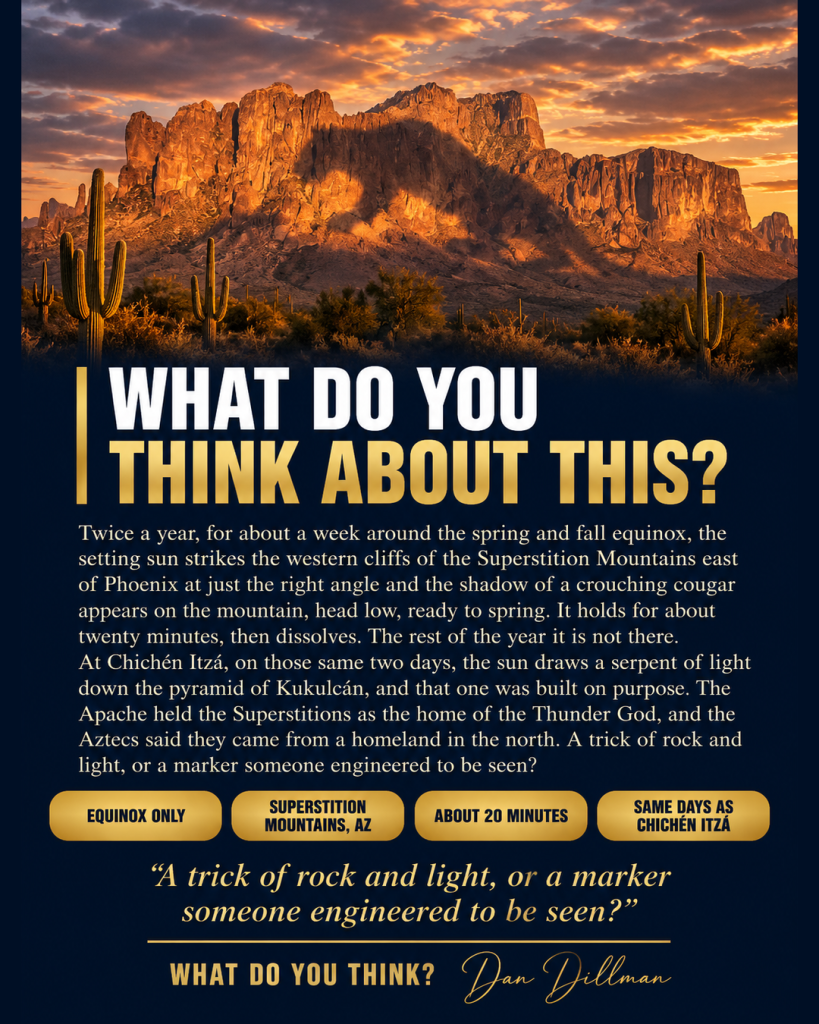

Twice a year, for about a week around the spring and fall equinox, something walks onto the Superstition Mountains east of Phoenix. About half an hour before sunset the light drops across the western cliffs at just the right angle, and the shadow of a crouching cougar appears on the face of the mountain, head low, shoulders bunched, as if it is about to spring down on Apache Junction. It holds for twenty or thirty minutes and then dissolves as the sun goes. People park along Goldfield Road to watch it. The rest of the year it is not there.
A shadow that only appears at the equinox has a famous cousin. At Chichén Itzá, on those same two days, the setting sun throws a chain of triangles down the north stairway of the great pyramid so that a serpent of light seems to slide down to the stone head at the bottom. That one was built on purpose. The Maya engineered a pyramid so the sky would draw Kukulcán, the feathered serpent the Aztecs called Quetzalcoatl, on the equinox and nowhere else. The equinox was the hinge of the Mesoamerican calendar.
The Superstitions were sacred long before the Lost Dutchman. The Apache held them as the home of the Thunder God and the doorway to the lower world, and the Hohokam who farmed the valley below tracked the sun with the care of any priest at Chichén Itzá. The Aztecs themselves said they came from a homeland in the north.
So here is the question. Is the cougar a trick of rock and light that a people who watched the equinox would simply have noticed and revered? Or did someone, a very long time ago, engineer the mountain and know exactly where to stand and when to look? What do you think?