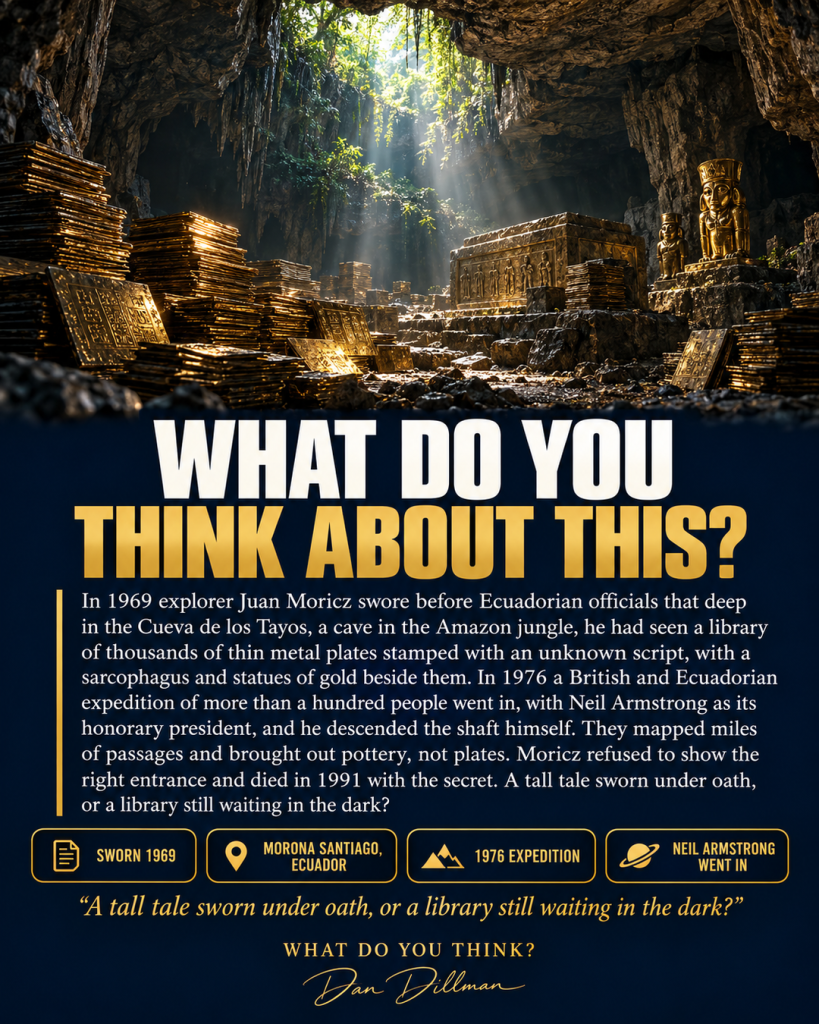

In 1969 an Argentine Hungarian explorer named Juan Moricz filed a sworn statement with the government of Ecuador. He claimed that deep inside the Cueva de los Tayos, a cave system in the Morona Santiago jungle, he had found a library: thousands of thin metal plates stamped with writing in an unknown script, stacked in a chamber along with a sarcophagus and statues of gold and stone. He said the Shuar people who guarded the cave had taken him in. He would not say exactly where.
The claim found its way into a bestselling book, and in 1976 a British Ecuadorian expedition of more than a hundred people went into the cave to settle it. Their honorary president was Neil Armstrong, seven years after the Moon, and he went down. The team mapped miles of passages and brought out pottery and burial goods. They did not find the library. Moricz had refused to guide them to the right entrance. He died in 1991 with the location unshared.
The cave is real, and strange on its own. The entrance is a 200 foot vertical shaft the Shuar descend on vine ladders once a year to gather oilbird chicks. Some of the passages have flat ceilings and square cut corners that visitors have said look worked rather than eroded. In 2018 a researcher reported a second entrance, a mile away, that may be the one Moricz used. Nobody has gone through it with a camera.
A metal library under the Amazon, a man who swore to it under oath, and an astronaut who went looking. What do you think?