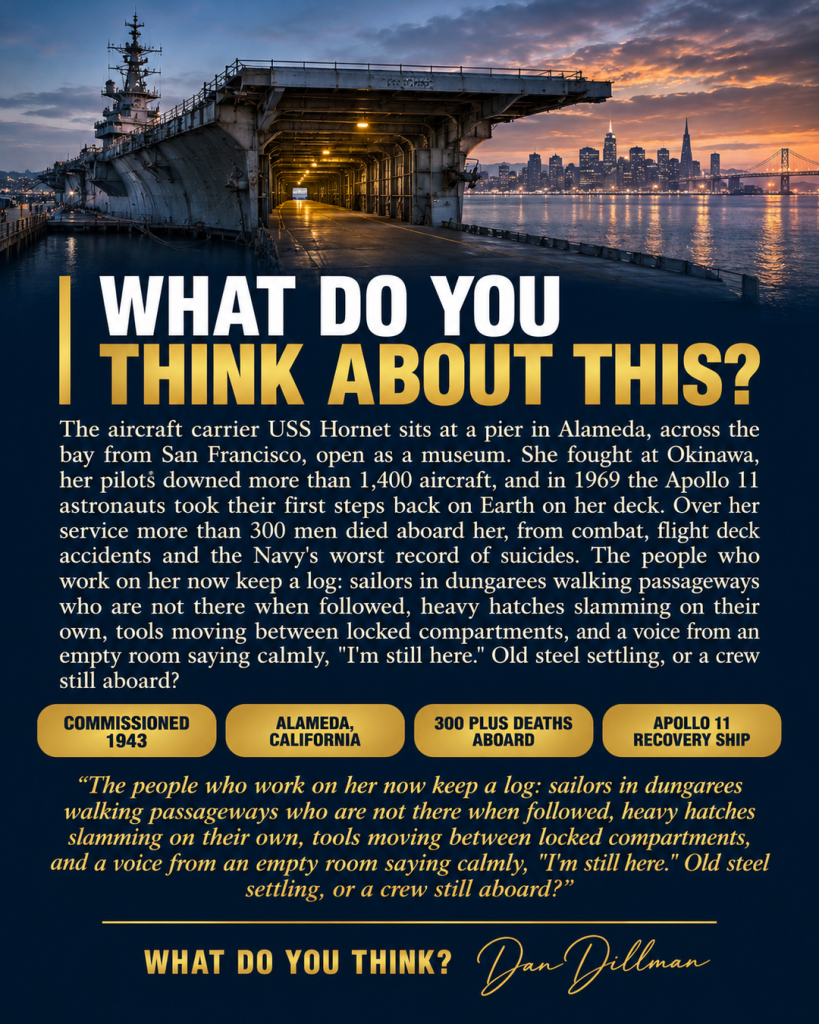

The aircraft carrier USS Hornet sits at a pier in Alameda, right across the bay from San Francisco, open to the public as a museum. She fought at the Philippine Sea and Okinawa. Her crews shot down 1,410 Japanese aircraft. In July 1969 her deck is where Neil Armstrong and Buzz Aldrin first stepped back onto a ship after the Moon. And over her 27 years of service, more than 300 men died aboard her, from combat, from accidents on the flight deck, and from the ship’s own grim record of suicides, said to be the highest in the Navy.
The people who work on her now will tell you she is not empty. Sailors in dungarees are seen walking passageways and are not there when you follow. Hatches that take two hands to open slam shut on their own. Tools go missing from locked compartments and turn up in the sick bay. Visitors feel a hand on their shoulder on the hangar deck and turn around to nobody. The ship’s own staff keep a log.
One story repeats more than any other. A docent locking up alone hears footsteps on the ladder below, calls out, gets no answer, and then hears a voice from the empty compartment say, calmly, “I’m still here.”
She is a 40,000 ton steel city that carried thousands of young men through the worst nights of their lives, and a few hundred never walked off. If anything can hold on to a place, it might be a ship. What do you think?