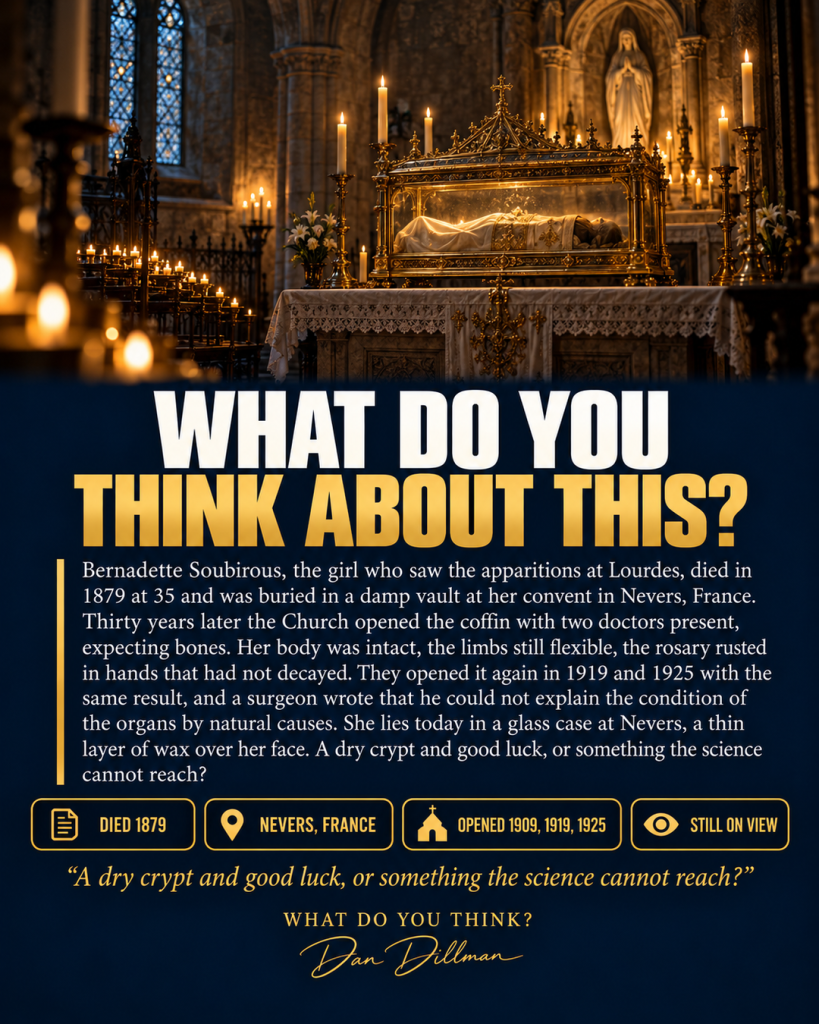

Bernadette Soubirous died in 1879 at the age of 35, the girl who had seen the apparitions at Lourdes twenty years earlier. She was buried in a damp vault at the convent in Nevers, France. Thirty years later, in 1909, the Church opened the coffin as part of her cause for sainthood. Two doctors were present. They expected bones.
They found her whole. The skin was dry, the face slightly sunken, but the body was intact, the arms and legs flexible, the rosary rusted in her hands while the hands themselves had not decayed. The nuns washed and reclothed her and put her back. In 1919 they opened the coffin again. Same result. In 1925 a third examination removed her ribs for relics and found the liver still soft, which the attending surgeon wrote was not something he could explain by natural causes.
Today she lies in a glass case in the chapel at Nevers. A thin layer of wax covers the face and hands, applied in 1925 because the skin had darkened. Under the wax is Bernadette.
She is one of more than a hundred so called incorruptibles, bodies the Catholic Church has documented as resisting decay without embalming: Saint Zita, dead since 1272, Saint Catherine of Bologna, seated upright in her chair since 1475. Some have been explained by dry crypts and lime. Some have not. A body in a wet vault for thirty years should not come out flexible. What do you think?