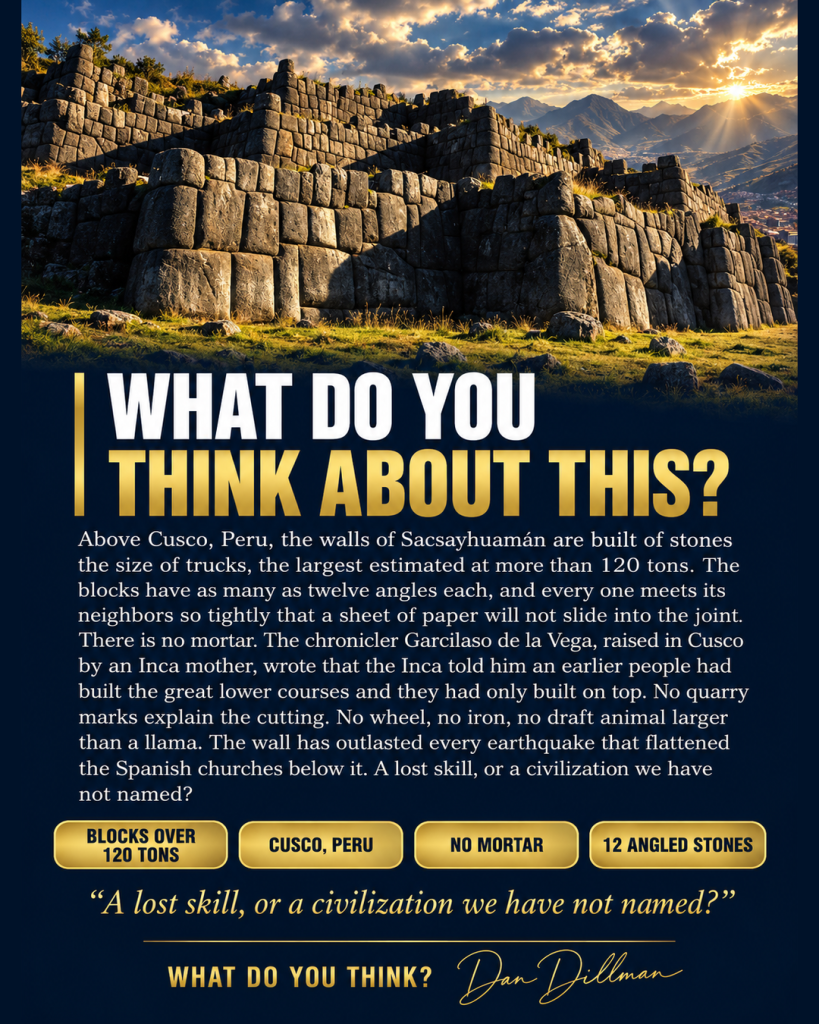

Above the city of Cusco, Peru, there is a wall built of stones the size of delivery trucks. The largest block at Sacsayhuamán is estimated at over 120 tons. The blocks are not square. They are many sided, some with twelve angles, and every one of them meets its neighbors so tightly that you cannot slide a sheet of paper into the joints. There is no mortar. The stones were shaped to fit each other like puzzle pieces, and the fit runs all the way through, not just on the visible face.
The Spanish chronicler Garcilaso de la Vega, who grew up in Cusco in the 1500s with an Inca mother, wrote that the Inca themselves told him the walls were there before them, raised by an earlier people. The Inca built on top. Their own masonry, the upper courses, is smaller and rougher. The giant polygonal blocks at the base are the mystery.
Nobody has shown how the stones were cut. The nearest quarry is miles away. There was no iron, no wheel, no draft animal bigger than a llama. Some blocks show surfaces that look melted or glazed rather than chipped. Local legend says the builders used the juice of a plant that softened stone, and that birds in the Andes still use it to drill nest holes into cliffs. Engineers who have tried to reproduce the joints with bronze tools have managed small stones, not 120 ton ones.
The wall has stood through five centuries of earthquakes that flattened the Spanish churches in the valley below. What do you think?