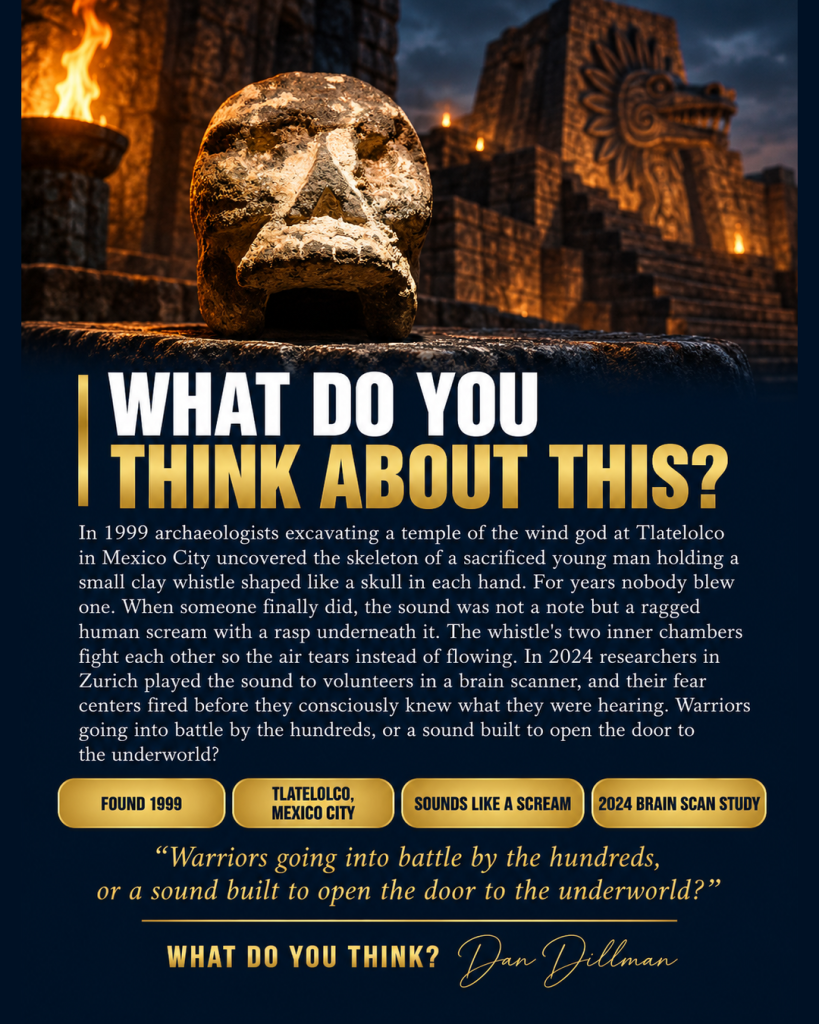

In 1999, during excavation of a temple to the wind god Ehecatl at Tlatelolco in Mexico City, archaeologists found the skeleton of a young man who had been sacrificed, and in each of his hands was a small clay whistle shaped like a skull. Nobody blew one for years. They were cataloged as ornaments.
When someone finally did, the room emptied. The sound that comes out of an Aztec death whistle is not a note. It is a scream, a ragged human shriek with a rasp underneath it, and it carries. The internal design is strange: two chambers that fight each other so the air tears instead of flowing. In 2024 a team in Zurich played the sound to volunteers in a brain scanner. The brain processed it as a human scream and lit up the fear centers before the listener consciously knew what they were hearing. The whistle appears to have been built, on purpose, to sound like someone dying.
What it was for is the question. One theory says warriors blew them by the hundreds going into battle, which would have been like the dead rushing the enemy line. Another says they belonged to Mictlantecuhtli, lord of the underworld, and were sounded during sacrifices to guide the soul down, or to make the wind god hear. The whistle was in the hands of a sacrificed man at a wind temple. That is where the evidence points.
A clay skull that screams, built five hundred years ago to work directly on the part of the mind that fears death. What do you think?