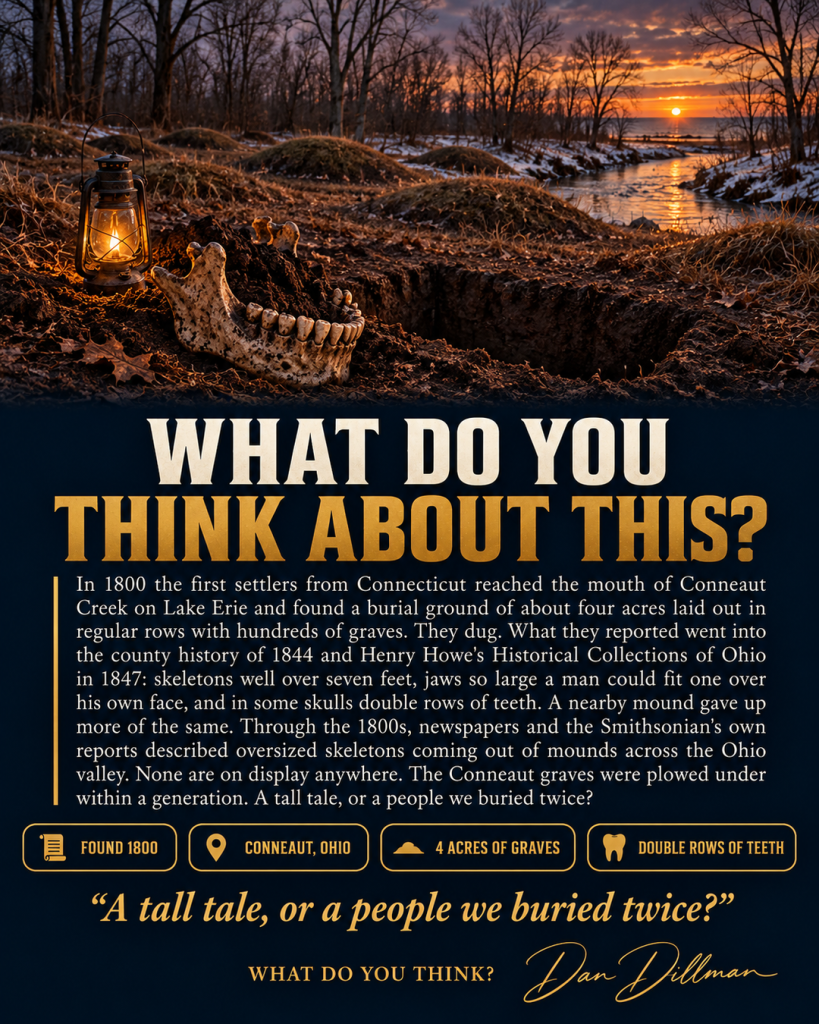
In 1800, when the first survey crews from Connecticut came to the mouth of Conneaut Creek on Lake Erie, in what is now Ohio, they found a burial ground. It covered about four acres and was laid out in regular rows, with hundreds of graves. The settlers started digging. What they said they found went into the county history, written down in 1844 by Harvey Nettleton and then repeated by Henry Howe’s Historical Collections of Ohio in 1847.
The skeletons were large. Nettleton wrote that the bones had belonged to a race of giants, that the jaws were so big a settler could fit one over his own face, that some skeletons measured well over seven feet, and that the teeth were double rows in some skulls. A nearby mound, opened by the town’s first settler, gave up more of the same, along with a few bones that the diggers thought showed signs of fire.
This is one report among hundreds. Through the 1800s, newspapers and county histories across the Ohio and Mississippi valleys reported oversized skeletons coming out of the mounds: at Cartersville, Georgia, at Kanawha in West Virginia, at Lake Delavan in Wisconsin in 1912. The Smithsonian’s own annual reports from the 1880s describe skeletons of seven feet and more being removed from mounds in West Virginia.
None of those bones are on display anywhere. The usual answer is that the measurements were wrong and the bones crumbled. The Conneaut graves were plowed under for farmland within a generation. What do you think?