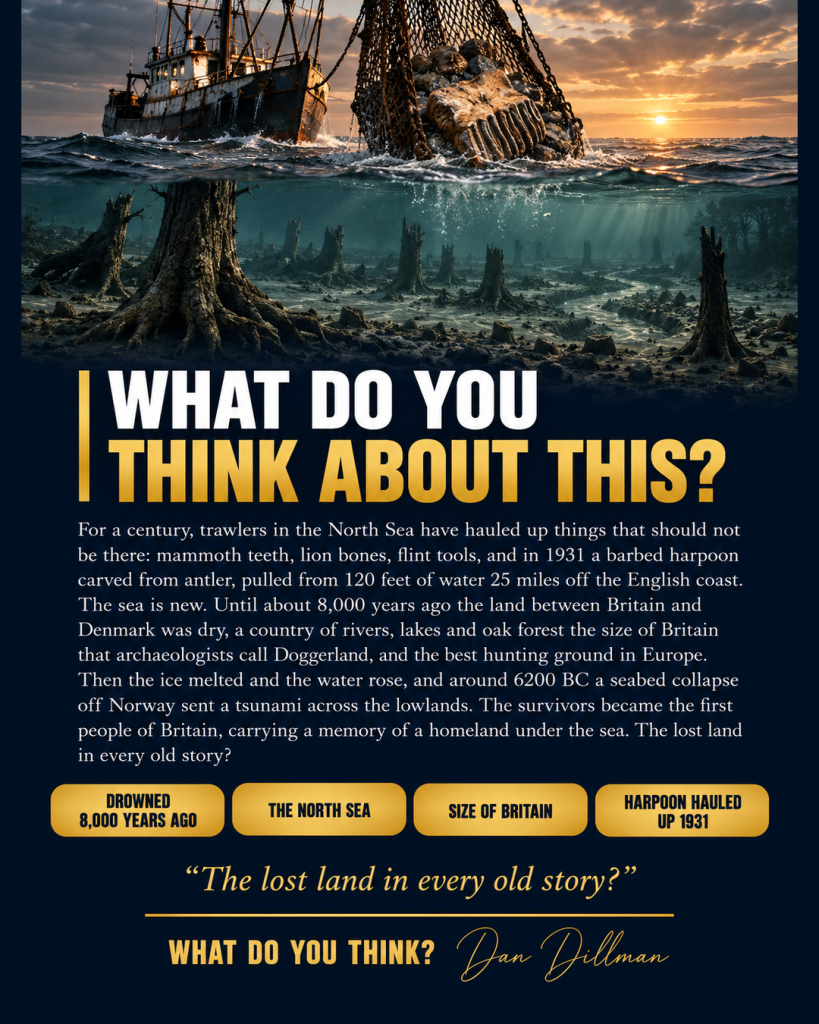
Fishermen in the North Sea have been pulling up things that should not be there for a century. Mammoth teeth. Lion bones. A barbed harpoon point carved from antler, hauled up in 1931 by the trawler Colinda from 120 feet of water, 25 miles off the English coast. Flint tools. Pieces of worked bone. Peat, with reeds still in it, from the bottom of the sea.
The reason is that the North Sea is new. Until about 8,000 years ago, the land between Britain and Denmark was dry. Archaeologists call it Doggerland. It was not a bridge, it was a country, a plain of rivers, lakes, marsh and oak forest about the size of Britain, and it was the best hunting ground in Europe. People lived on it for thousands of years. By seismic mapping from oil surveys, researchers have traced its river valleys, its coastline, and a lake the size of a small sea in the middle.
Then it drowned. The ice sheets melted and the water rose, slowly at first, then in a catastrophe. Around 6200 BC a shelf of seabed off Norway collapsed, the Storegga Slide, and sent a tsunami across the lowlands that may have been the end of whoever was still there. The survivors would have become the first people of Britain, carrying a memory of a homeland under the water.
Every culture on the Atlantic rim tells a story of a land lost beneath the sea. The North Sea has one underneath it, and we have its fishhooks. What do you think?