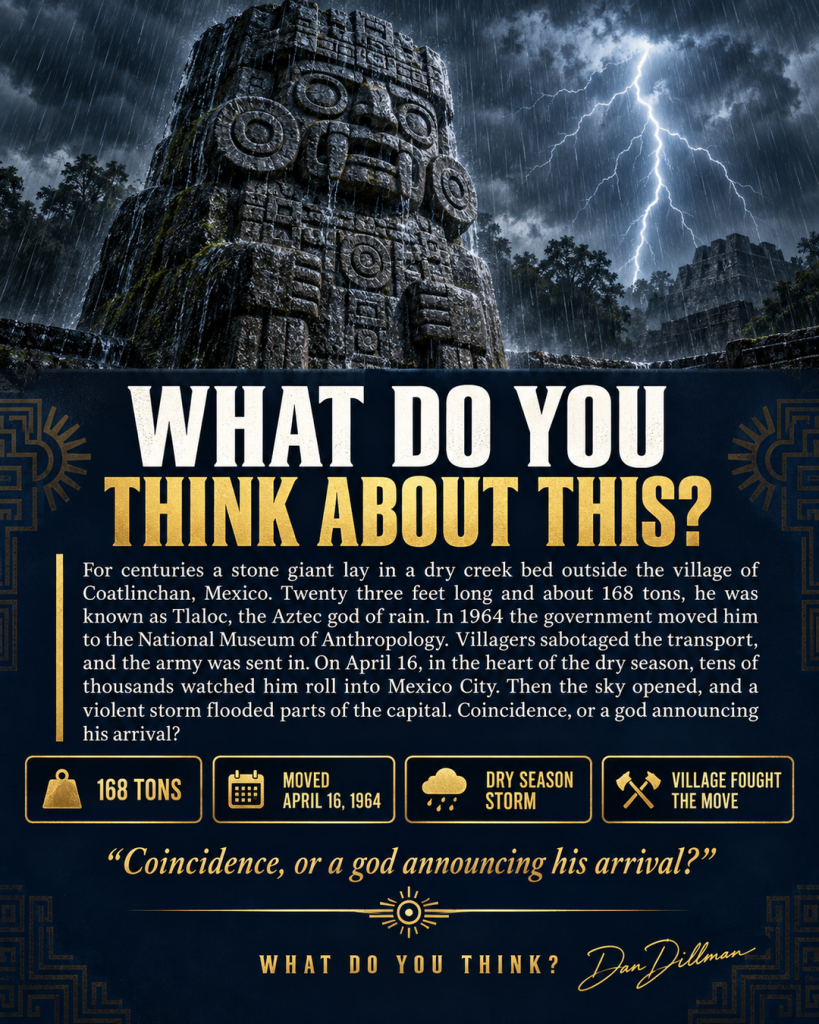
For centuries a giant lay on his back in a dry creek bed outside the village of Coatlinchan, east of Mexico City. He was carved from a single block of stone, twenty three feet long and about 168 tons, one of the largest monoliths ever cut in the Americas. The villagers called him Tlaloc, the Aztec god of rain, and they believed he was the reason their fields stayed green.
In 1964 the Mexican government decided he belonged in front of the new National Museum of Anthropology. The people of Coatlinchan disagreed. When the engineers arrived, villagers sabotaged the transport rig and slashed its tires, and the army had to be sent in to hold the town while the stone was lifted onto a custom trailer rolling on dozens of wheels.
On April 16 the rain god made his slow journey into the capital. Power lines were taken down to let him pass. Tens of thousands of people lined the streets and packed the Zócalo at night to watch him arrive.
And then the sky opened. April is the heart of the dry season in Mexico City, and yet witnesses and newspapers recorded a violent storm that flooded parts of the city as Tlaloc rolled in. One of the heaviest downpours anyone could remember for that time of year.
The engineers called it weather. The people of Coatlinchan say their rains have never been the same since he left.
Some scholars now argue the statue is not Tlaloc at all, but the water goddess Chalchiuhtlicue. Either way, the water answered.
Makes you wonder what our ancestors understood about these stones that we have forgotten.
Coincidence, or a god announcing his arrival?