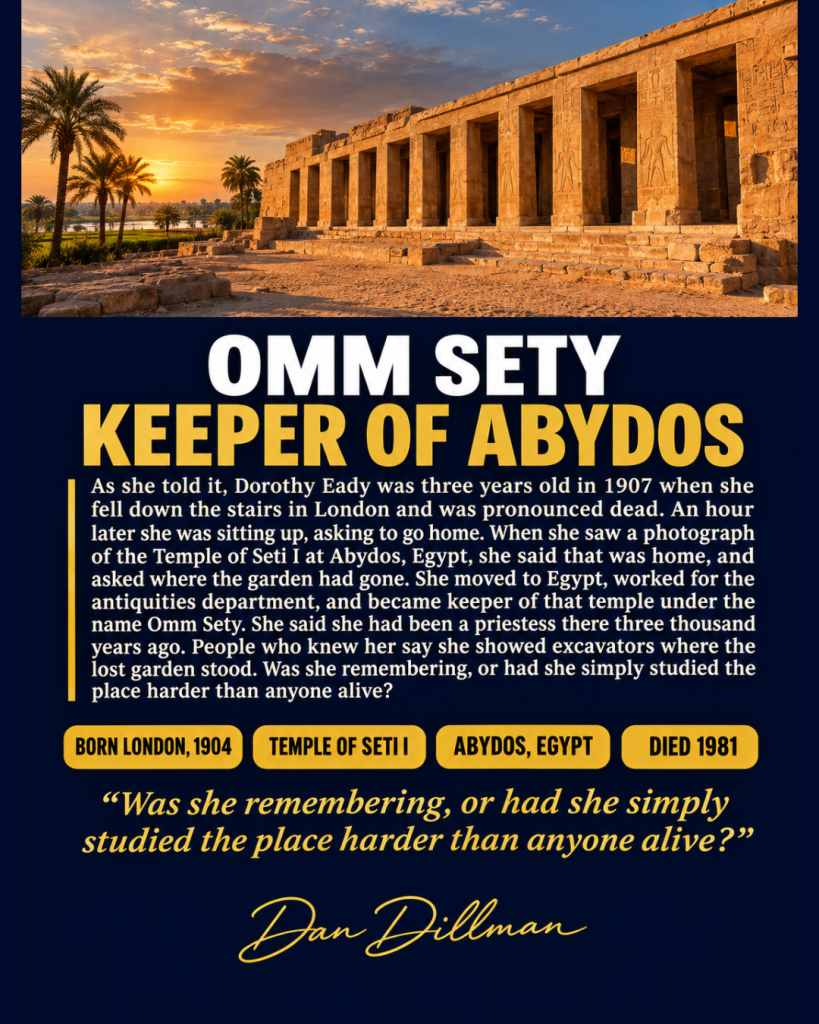
In 1907, the story goes, a three year old London girl named Dorothy Eady fell down a flight of stairs. The doctor examined her, pronounced her dead, and left to make arrangements. When he came back an hour later she was sitting up in bed, playing.
She was not the same child after that. She cried to be taken home and could not say where home was. At the British Museum she ran through the Egyptian rooms kissing the feet of the statues and would not leave. Then her father brought home a magazine with a photograph of the Temple of Seti I at Abydos. That was her home, she told him. But why was it broken, and where was the garden?
Those are her memories, as she told them all her life. What came next is on the record. She taught herself hieroglyphs, married an Egyptian, and moved to Cairo in her twenties. Their son was named Sety, and by local custom she became Omm Sety, mother of Sety. She worked for the antiquities department as a draftswoman and became keeper of the very temple in the photograph. Egyptologists who did not share her beliefs relied on what she knew.
She said she had been Bentreshyt, a young priestess at Abydos, three thousand years ago, and that she had simply come back.
People who knew her told two stories. In one, an inspector tests her by naming wall scenes and sending her to find them in the dark. She walks straight to each. In the other, she shows the excavators where the temple garden once stood. They dig, and there are the tree stumps.
Could it be she was remembering, or had she simply studied the place harder than anyone alive?