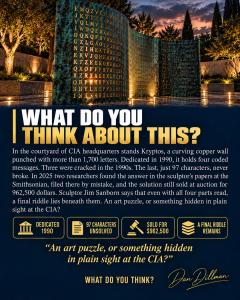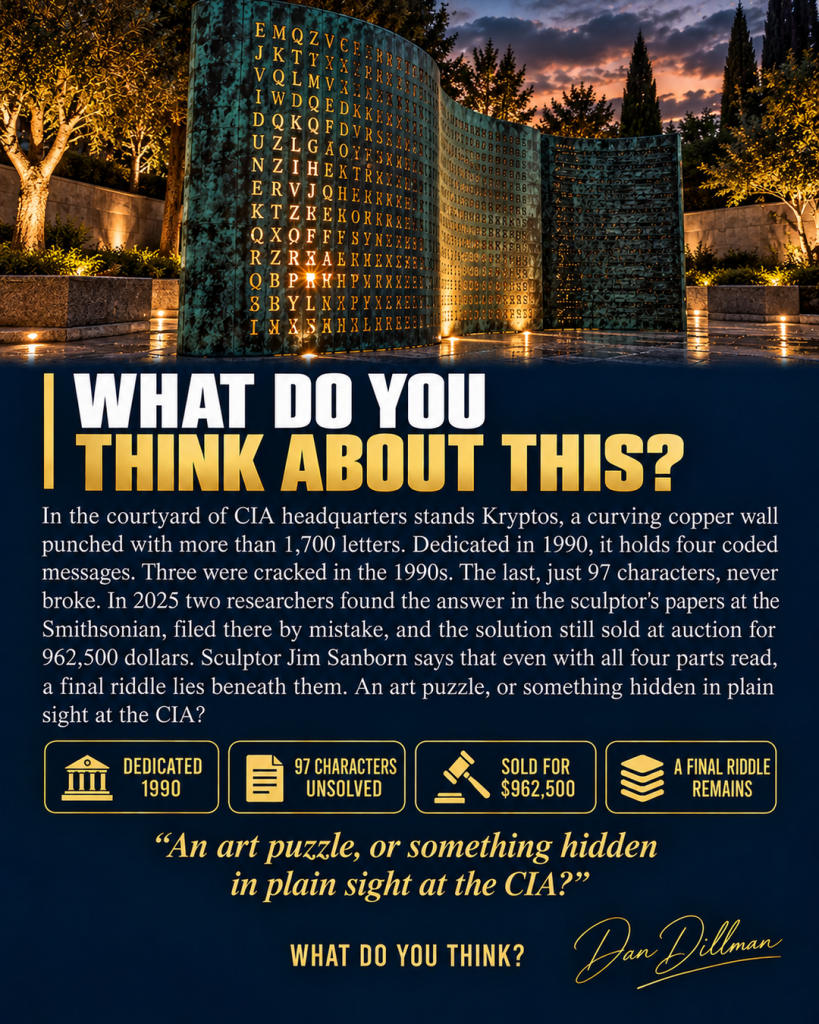
In the courtyard of CIA headquarters in Langley, Virginia, stands a curving wall of copper punched with more than 1,700 letters. It is called Kryptos, it was dedicated in November of 1990, and for thirty five years the best codebreakers on Earth have walked past it on their lunch break unable to read the last line.
The sculptor, Jim Sanborn, divided his message into four parts. The first three fell in the 1990s, cracked separately by an NSA team, a CIA analyst working on his own time, and a California computer scientist. One passage describes Howard Carter breaking through into the tomb of Tutankhamun. Another gives coordinates and asks, does Langley know about this, they should, it is buried out there somewhere.
The fourth part, just 97 characters, never broke. Sanborn released clues over the years, the words BERLIN, CLOCK, NORTHEAST and EAST. Nothing.
Then in 2025, with Sanborn nearing eighty, he announced he would auction the solution. Weeks before the sale, two researchers found the answer sitting in his papers at the Smithsonian archives, filed there by mistake. They had the plain text. They still do not know how the cipher works. The auction went ahead anyway and the secret sold for 962,500 dollars to an anonymous buyer.
And Sanborn has said for years that even when all four parts are read, there is a final riddle underneath them. Something about that courtyard. Something buried.
What if the real message was never meant for codebreakers at all.
An art puzzle, or something hidden in plain sight at the CIA?