In 1532 Francisco Pizarro captured the Inca emperor Atahualpa at Cajamarca. Atahualpa saw what the Spaniards wanted and made an offer: he would fill the room where he was held once with gold and twice with silver in exchange for his life. Gold came in from across the empire for months. In July of 1533 Pizarro had him executed anyway.
That much is history. The rest is one of the great treasure legends of South America.
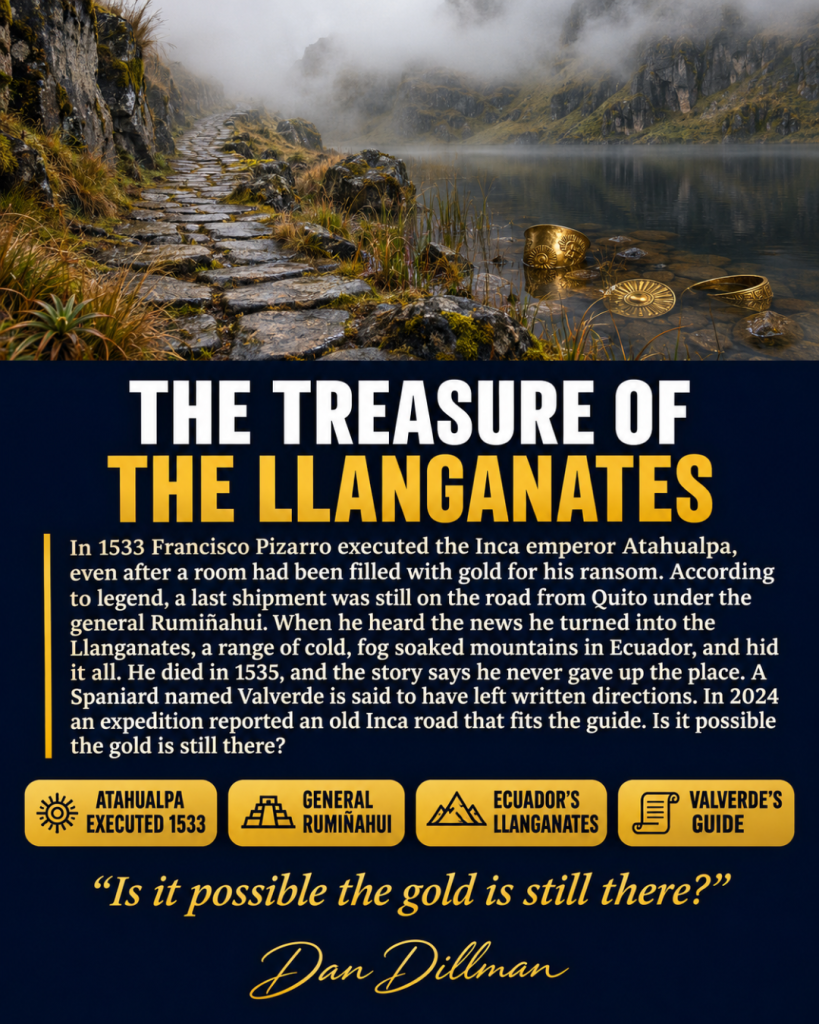
According to the legend, a last shipment was still on the road from Quito under the Inca general Rumiñahui, carried on the backs of thousands of porters. When word of the execution reached him, Rumiñahui turned east into the Llanganates, a range of cold, fog soaked mountains in what is now Ecuador, and hid all of it. Some say in a cave. Some say at the bottom of a lake. The Spanish captured and tortured him. He died in 1535, and the story says he never gave up the place.
About fifty years later, the legend continues, a Spaniard named Valverde who had married into a local family became suddenly rich, and on his deathbed wrote out directions for the King of Spain, landmark by landmark. Around 1860 the English botanist Richard Spruce found a copy of that guide in Ecuador, along with an old map of the same mountains.
People have followed Valverde’s guide ever since, and some have died trying. In 2024 an expedition led by photographer Jorge Juan Anhalzer reported an old Inca road in the range that fits the guide’s description, and reached a large lagoon. They did not search the water.
Is it possible the gold is still sitting where the legend says a general left it?