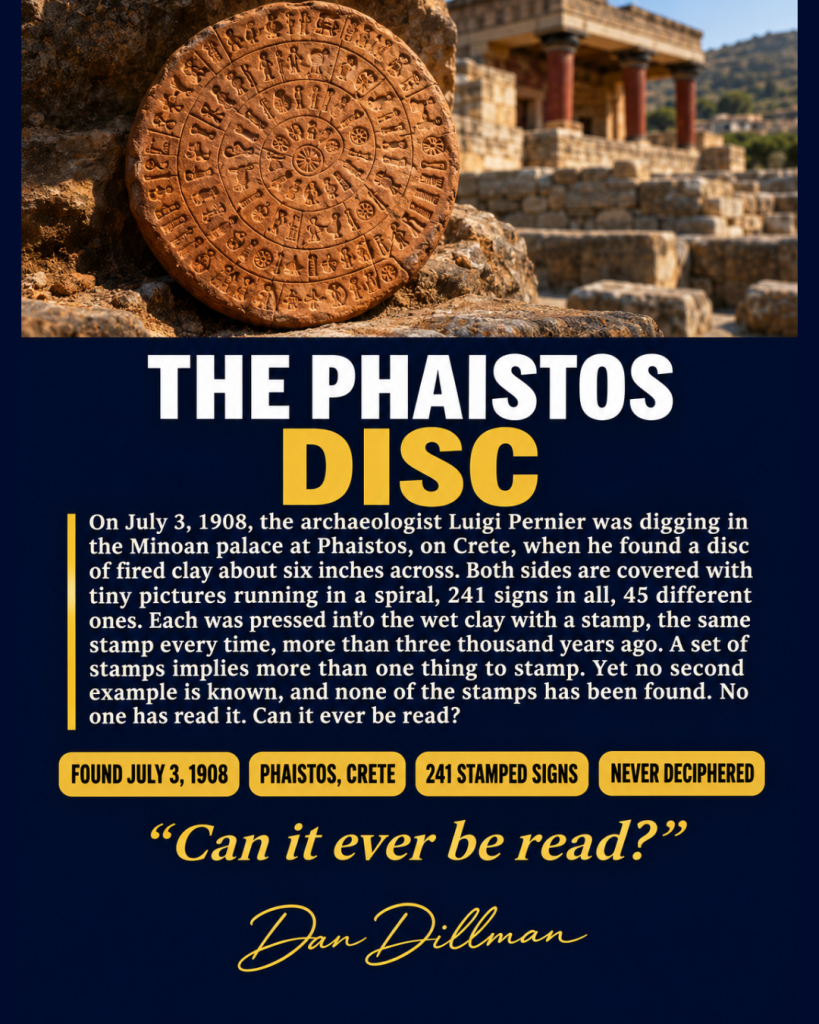
On July 3, 1908, an Italian archaeologist named Luigi Pernier was digging in a basement room of the Minoan palace at Phaistos, on the south coast of Crete. In the fill he found a disc of fired clay about six inches across, intact, and covered on both sides with tiny pictures running in a spiral from the rim to the center.
There are 241 of them. A walking man. A head with a feathered crest. A fish, a bird, a shield, a branch, a woman, a boat. Count the different ones and you get 45. That is more than most alphabets use and far fewer than a full picture script would need, so many researchers suspect each sign stands for a syllable. The count alone cannot prove it.
The signs were not scratched in by hand. Each one was pressed into the wet clay with a stamp, the same stamp every time that sign appears. Somebody cut a set of punches and used them to set down a text, more than three thousand years ago. It is often described as one of the earliest uses of reusable type.
A set of stamps implies more than one thing to stamp. Yet no second example of this disc is known, and none of the stamps has been found.
So we have a single stamped document in an unknown script, in an unknown language, with no second text to compare it against. There have been dozens of claimed translations, a prayer, a calendar, a hymn, a game board. None has convinced the field, because with only 241 signs almost anything can be made to fit.
It sits in the archaeological museum at Heraklion. Makes you wonder what else those stamps were used for. Can it ever be read?