MYSTERIOUS X WORK WITH DAN

X-FILES

The Sphinx Water Erosion Question

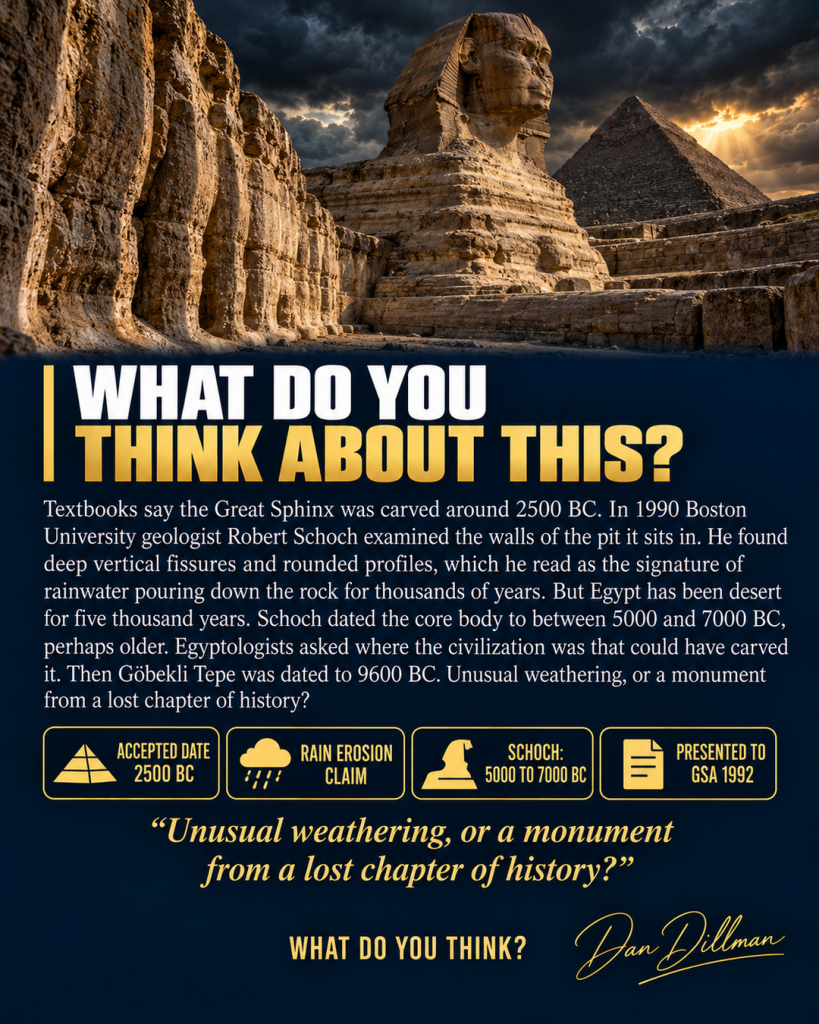
For more than a century every textbook has given the same answer. The Great Sphinx of Giza was carved around 2500 BC, in the reign of the pharaoh Khafre. Then a geologist went and looked at the rock.

In 1990 Robert Schoch, a professor at Boston University with a doctorate in geology from Yale, traveled to Egypt at the invitation of the independent researcher John Anthony West. Schoch expected to settle the matter quickly. Instead he found himself staring at the walls of the pit the Sphinx sits in.

They are cut with deep vertical fissures and rounded, rolling profiles. To a geologist, he said, that is the classic signature of rainwater, of water pouring down the rock face for thousands of years. Wind and sand leave a different mark, sharp horizontal scouring, and you can see it on other Giza monuments of the accepted age.

The problem is that Egypt has been desert for the last five thousand years. The last time heavy rains fell on Giza was far earlier. Schoch put the carving of the core body somewhere between 5000 and 7000 BC, and perhaps much older.

When he presented his findings to the Geological Society of America in 1992, many fellow geologists agreed with his reading of the rock. Egyptologists did not. One asked where the civilization was that could have done it. There was no evidence, they said, of anyone that advanced, that early.

That was before Göbekli Tepe was dug out of a hill in Turkey and dated to 9600 BC.

What if the Sphinx was already ancient when the first pharaoh laid eyes on it.

Unusual weathering, or a monument from a lost chapter of history?
Leave a Reply

Your email address will not be published. Required fields are marked *

KEEP DIGGING

The Falcon Lake Incident

What do you think about this? On May 20, 1967, a prospector in Manitoba walked up to a landed craft near Falcon Lake. It blasted him with hot gas and left a grid of burns on his chest matching its vents. Three governments investigated. Canada put it on a coin. Hoax, or the real thing?

Read More »

Serpent Mound

What do you think about this? Serpent Mound in Ohio is a 1,348 foot snake of earth, its head aimed at the summer solstice sunset, its body built on the rim of an ancient meteor crater. One dating puts it right after Halley’s Comet in 1066. Sacred art, or a message for the sky?

Read More »

The Taos Hum

What do you think about this? Since the early 1990s about two percent of people in Taos, New Mexico, hear a low hum like a distant diesel that never shuts off. In 1993 Los Alamos and Sandia scientists came to find it. Their instruments found nothing. Trick of the ear, or a hidden signal?

Read More »

The Honey Island Swamp Monster

What do you think about this? In 1974 a retired air traffic controller cast footprints in Louisiana’s Honey Island Swamp: three webbed toes, a foot long. He had reported a seven foot gray haired creature with yellow eyes standing over a dead boar in 1963. Hoax, or the Letiche?

Read More »

The Zeitoun Apparitions

What do you think about this? For nearly three years beginning April 2, 1968, a glowing figure of a woman appeared on the roof of a church in Cairo, seen by crowds of tens of thousands, Christians and Muslims together, and caught in press photographs. Mass illusion, or a visitation?

Read More »

The Saqqara Bird

What do you think about this? A 2,200 year old wooden bird dug up at Saqqara in 1898 has no legs, no feathers, straight wings and a tail that stands upright like the fin of an airplane. Some replicas glide. A child’s toy that looks like a plane, or a memory of something that flew?

Read More »

MYSTERIOUS X

DECLASSIFIED

Field reports, theories, and intel from the X-Files straight to your inbox. No filler, no algorithms, just the work.

Phone is optional. If you add it, we may text you tour drops, book launches, and breaking news from the X-Files up to 4 messages a month. Reply STOP anytime. Msg & data rates may apply.