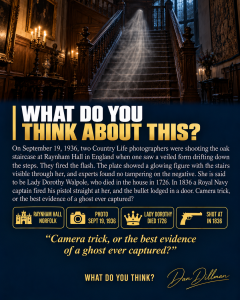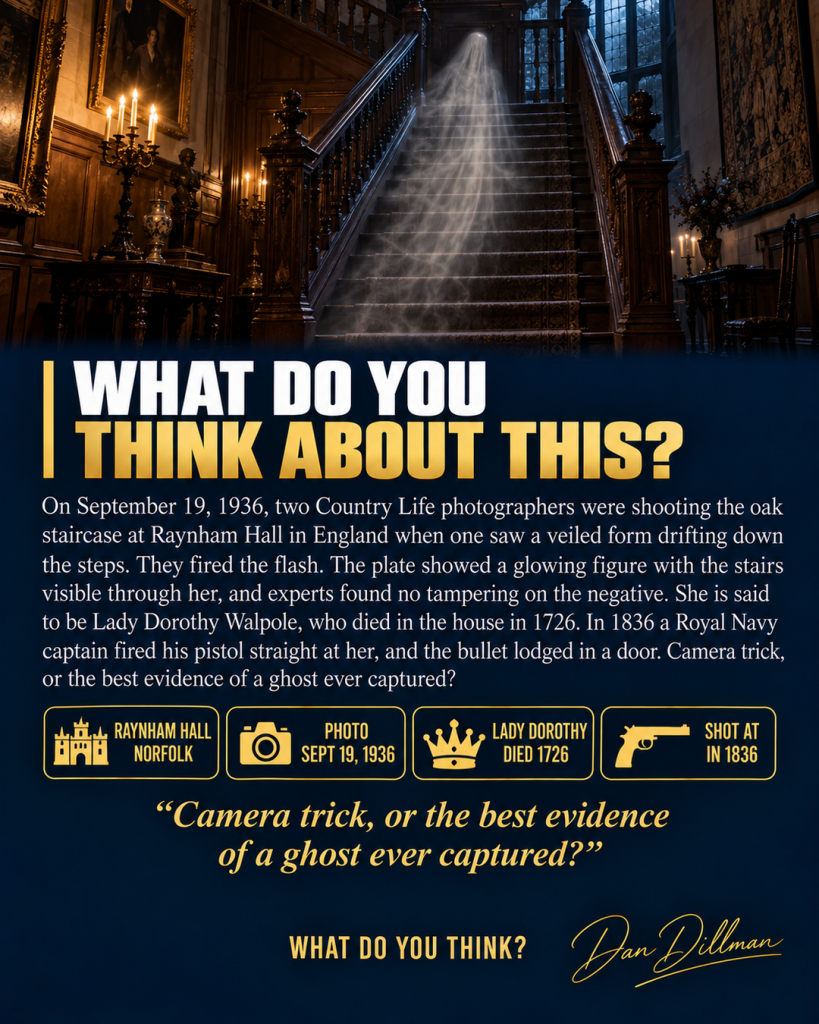
On September 19, 1936, two photographers from Country Life magazine were shooting the grand oak staircase at Raynham Hall in Norfolk, England. One of them, Indre Shira, suddenly saw a veiled form drifting down the steps toward them. He shouted. His partner, Captain Hubert Provand, pulled the cap off the lens while Shira fired the flash.
When the plate was developed, there she was. A tall, glowing figure in what looks like a gown and veil, descending the stairs, with the steps visible right through her. Country Life published it that December. It remains perhaps the most famous ghost photograph ever taken, and experts who examined the original negative at the time said they could find no sign of tampering.
The photographers had not invented her. The Brown Lady had been seen at Raynham for a hundred years. She is said to be Lady Dorothy Walpole, sister of Britain’s first prime minister, who died in the house in 1726 after her husband reportedly locked her away from her children. Witnesses describe a woman in a brown brocade dress with a glowing face and dark, empty sockets where her eyes should be.
In 1836 the novelist Captain Frederick Marryat, a hardened Royal Navy officer, asked to sleep in the haunted room to prove it was nonsense. He met her in the corridor carrying a lamp. He said she grinned at him. He fired his pistol straight at her, and the bullet passed through and lodged in a door.
Skeptics say double exposure, or grease on the lens. Maybe so.
Makes you wonder why she has barely been seen since that photograph was taken.
Camera trick, or the best evidence of a ghost ever captured?