
What do you think about this?
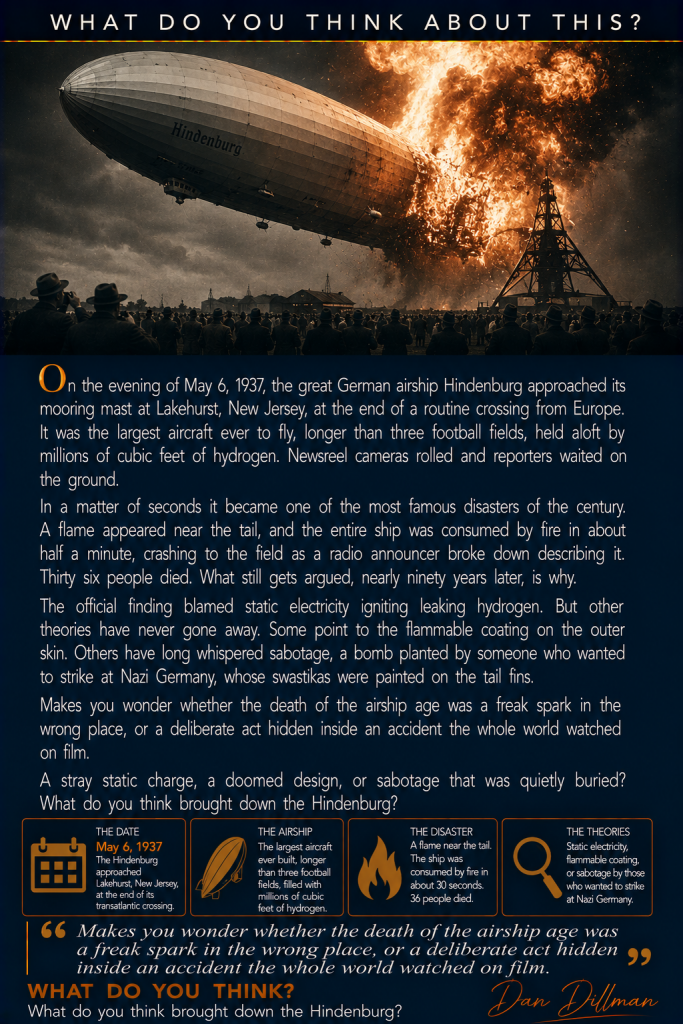
On the evening of May 6, 1937, the great German airship Hindenburg approached its mooring mast at Lakehurst, New Jersey, at the end of a routine crossing from Europe. It was the largest aircraft ever to fly, longer than three football fields, held aloft by millions of cubic feet of hydrogen. Newsreel cameras rolled and reporters waited on the ground.
In a matter of seconds it became one of the most famous disasters of the century. A flame appeared near the tail, and the entire ship was consumed by fire in about half a minute, crashing to the field as a radio announcer broke down describing it. Thirty six people died. What still gets argued, nearly ninety years later, is why.
The official finding blamed static electricity igniting leaking hydrogen. But other theories have never gone away. Some point to the flammable coating on the outer skin. Others have long whispered sabotage, a bomb planted by someone who wanted to strike at Nazi Germany, whose swastikas were painted on the tail fins.
Makes you wonder whether the death of the airship age was a freak spark in the wrong place, or a deliberate act hidden inside an accident the whole world watched on film.
A stray static charge, a doomed design, or sabotage that was quietly buried? What do you think brought down the Hindenburg?