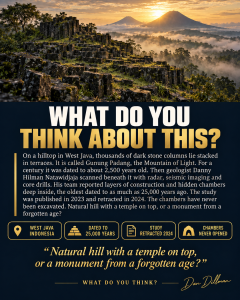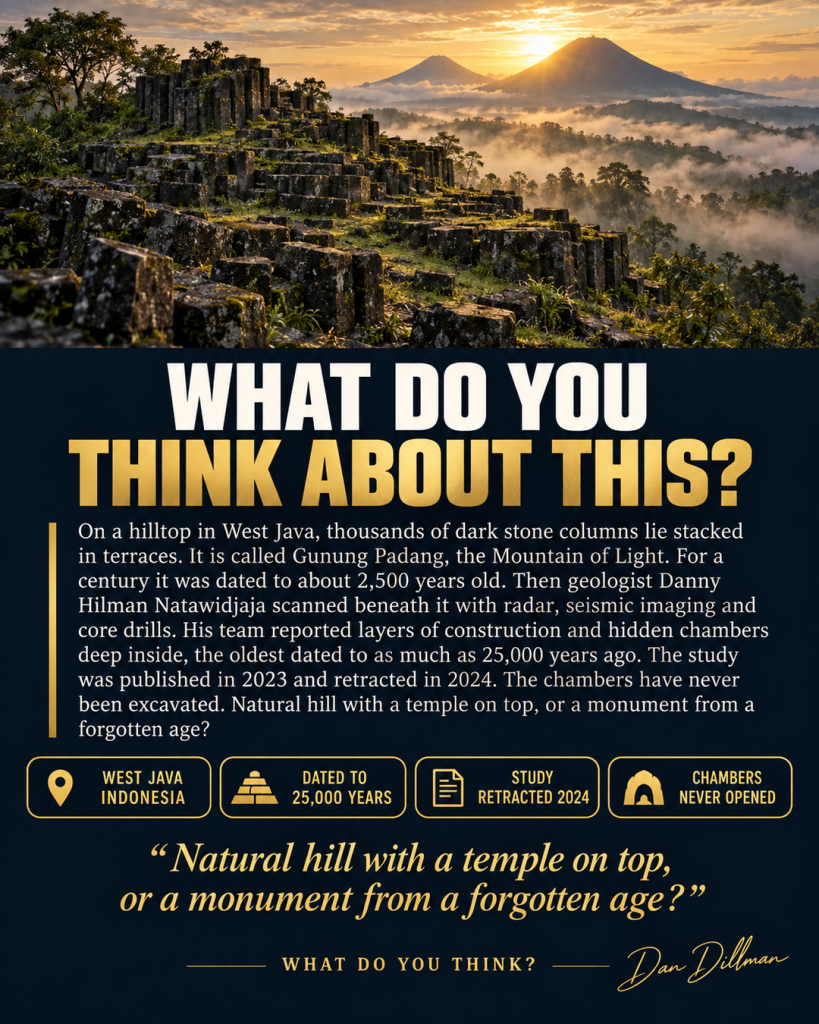
On a hilltop in West Java, thousands of dark stone columns lie stacked in terraces like the bones of something enormous. The locals call it Gunung Padang, the Mountain of Light, and they have treated it as sacred for longer than anyone can remember.
Dutch surveyors noted the site in 1914. For a century it was filed away as a megalithic terrace perhaps 2,500 years old, impressive but ordinary. Then Indonesian geologist Danny Hilman Natawidjaja began looking under it. His team used ground penetrating radar, seismic imaging and core drilling, and what they reported was astonishing. The hill, they said, is not a hill. It is layer upon layer of construction, with chambers and cavities deep inside, and the oldest layers carbon dated to as much as 25,000 years ago.
That would make it older than Göbekli Tepe. Older than farming. Older than anything we are told humans were capable of building.
The paper was published in 2023 and the reaction was swift. Archaeologists argued that the dated soil showed no sign of human hands, and in 2024 the journal retracted the study. The authors called it unfair. The chambers they detected have still never been excavated.
I keep coming back to that last part. Nobody has dug down to look.
What if the oldest pyramid on Earth is sitting under a hillside in Indonesia, waiting for someone with the nerve to open it.
Natural hill with a temple on top, or a monument from a forgotten age?