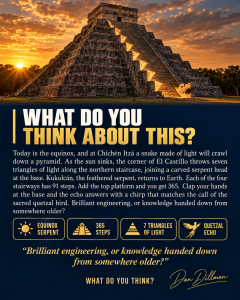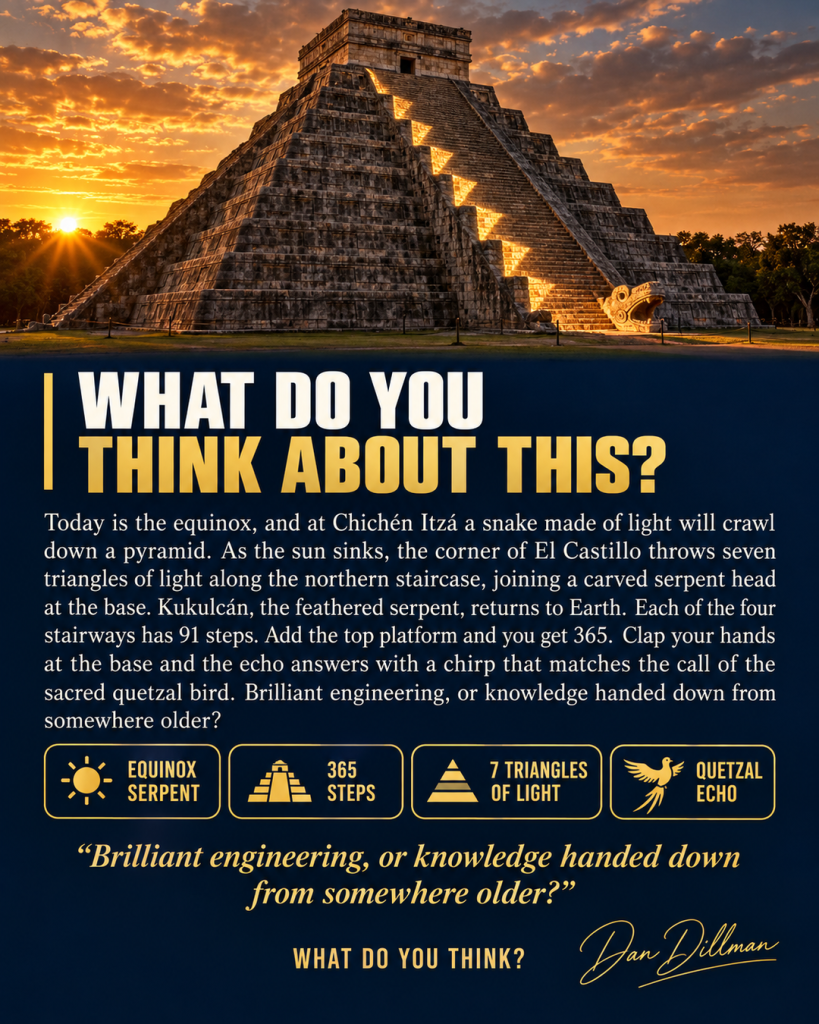
Late this afternoon, as the sun drops toward the horizon in the Yucatan, a snake made of light will crawl down the side of a pyramid.
It happens at Chichén Itzá, on the great stepped temple the Spanish called El Castillo. For a few hours around the equinox, the corner of the pyramid throws a row of seven triangles of light along the northern staircase. They ripple downward and join a massive carved serpent head waiting at the base. The feathered serpent, Kukulcán, returns to Earth.
Nothing about this building is an accident. Each of its four stairways has 91 steps. Add the top platform and you get 365, one for every day of the solar year. The Maya who raised it around a thousand years ago tracked Venus, predicted eclipses and kept calendars more accurate than the one Europe was using at the time.
And then there is the sound. Stand in front of the staircase and clap your hands. The echo that comes back is not a clap. It is a chirp, and acoustic engineers have shown it closely matches the call of the quetzal, the sacred bird whose feathers crowned the serpent god.
Light that moves like a snake. Stone that answers with the voice of a bird. All of it built without metal tools or the wheel.
Makes you wonder what else they knew, and how much of it burned when the Spanish put the Maya books to the torch.
Brilliant engineering, or knowledge handed down from somewhere older?