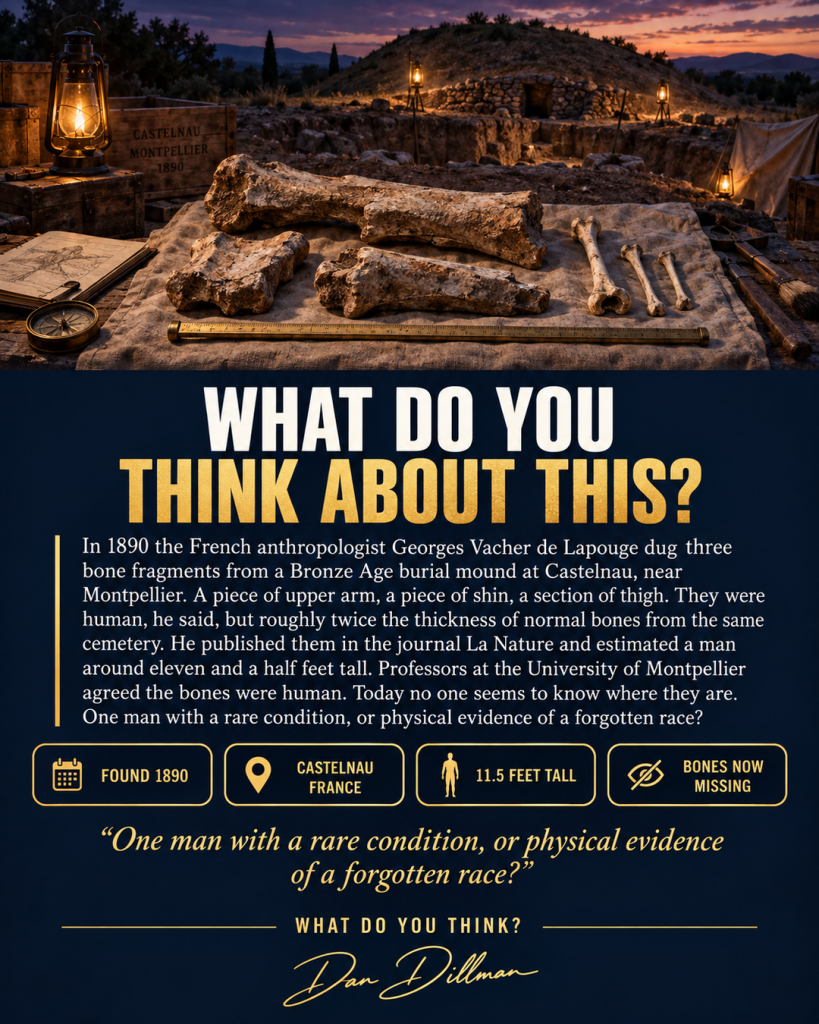
In the winter of 1890 a French anthropologist named Georges Vacher de Lapouge was digging through a Bronze Age burial mound at Castelnau, near Montpellier, when he pulled out three pieces of bone that did not make sense.
A piece of upper arm. A piece of shin. A section of thigh bone. They were human in every respect except one. They were roughly twice the thickness of the normal bones found in the same cemetery.
Lapouge published his find in the science journal La Nature, with a drawing of the bones laid beside ordinary ones for comparison. He estimated the owner had stood around eleven and a half feet tall. The fragments were studied at the University of Montpellier, where a professor of zoology and a professor of pathological anatomy both examined them. They agreed the bones were human. One suggested the owner may have suffered from a growth disorder.
Then, in 1894, newspapers reported that workers digging a reservoir in the same area had uncovered human skulls of enormous size, and that these were sent to the Paris Academy of Sciences. After that the trail goes cold. No follow up study. No museum display. No one seems to know where any of it is today.
Almost every ancient culture tells of giants. The Bible, the Greeks, the Norse, the Paiute, the Aztecs. We are told these are all just stories.
But these bones were measured, drawn and published by trained scientists.
The truth may be far stranger than we have been told.
One unlucky man with a rare condition, or physical evidence of a forgotten race?