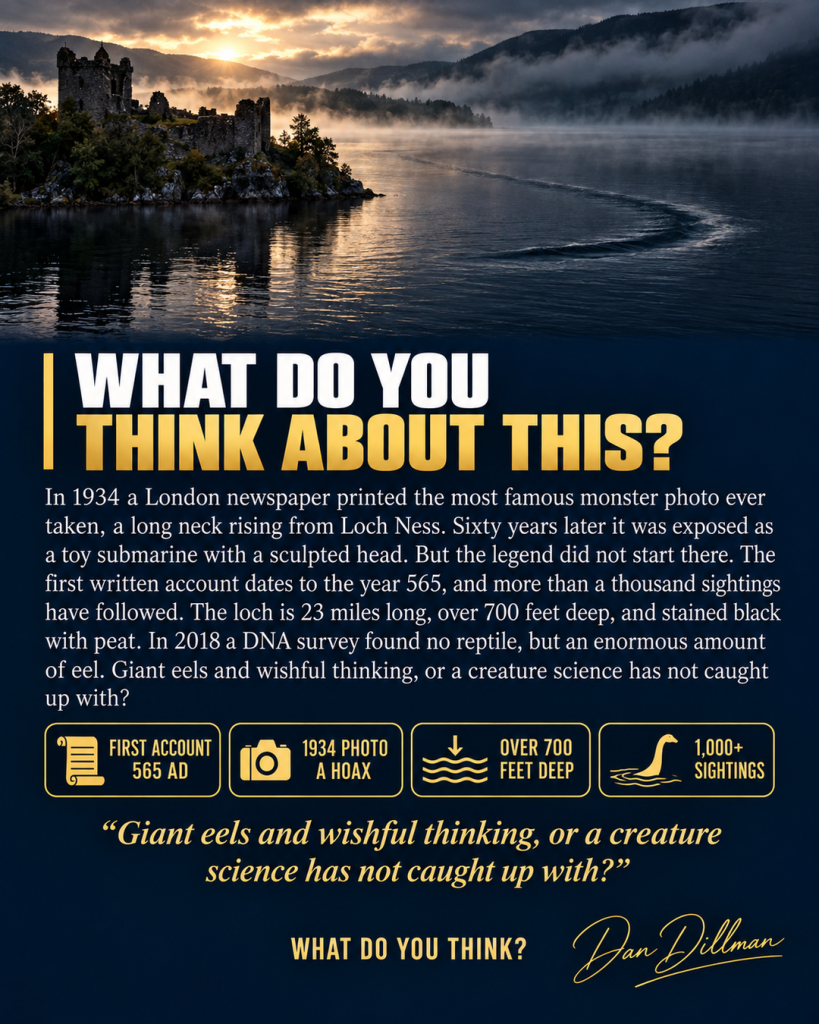
In April of 1934 a London newspaper printed the most famous monster photograph ever taken. A long neck and small head rising from the dark water of Loch Ness, credited to a respected London surgeon. It fooled the world for sixty years.
In 1994 the truth came out. The monster was a toy submarine with a sculpted head, about a foot tall, floated by a big game hunter who wanted revenge on the newspaper that had humiliated him. Case closed, the skeptics said.
Except the story of the loch does not begin with that photo, and it did not end with it.
The first written account dates to the year 565, when the Irish monk Saint Columba is said to have ordered a beast in the River Ness to leave a swimmer alone. More than a thousand sightings have been logged since, many by people with nothing to gain, police officers, priests, a team of sonar operators. The loch itself is a fine place to hide. It is 23 miles long, more than 700 feet deep, and holds more fresh water than every lake in England and Wales put together. The water is stained so dark with peat that a diver cannot see his own hand a few feet down.
In 2018 scientists sampled DNA from across the loch. No reptile. But an enormous amount of eel.
One fake photograph does not explain a legend fifteen centuries old.
Is it possible that something large and unknown still moves through that black water.
Giant eels and wishful thinking, or a creature science has not caught up with?