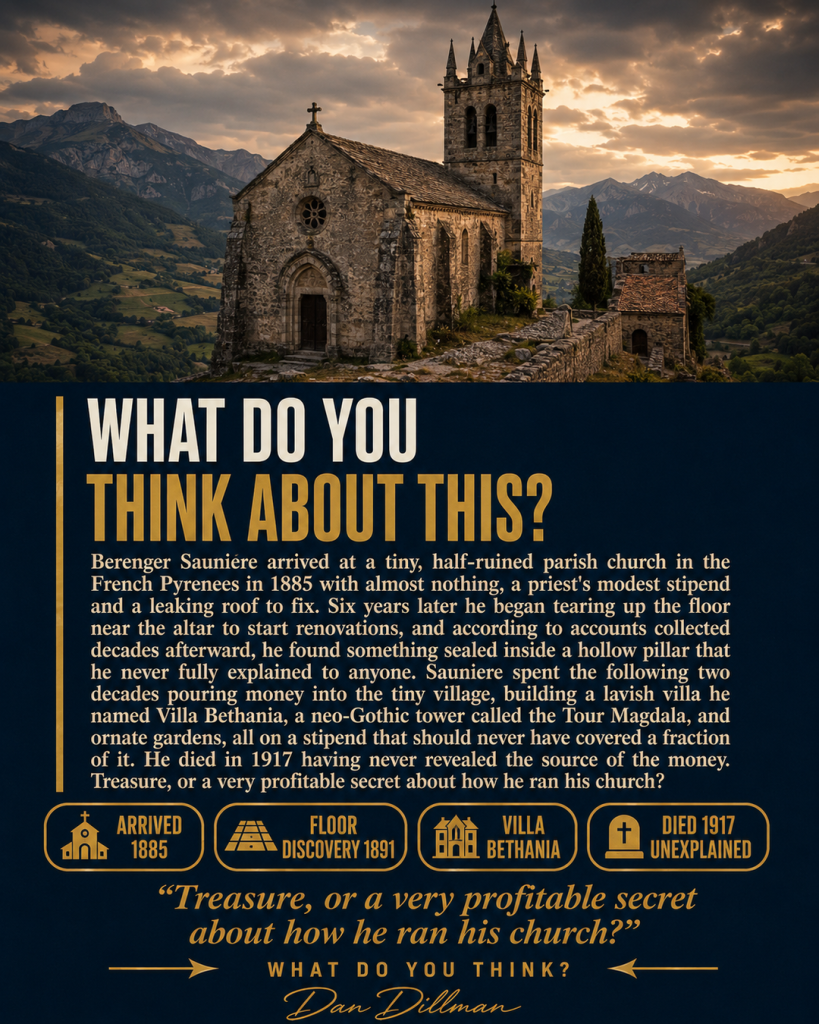

Bérenger Saunière arrived at a tiny, half-ruined parish church in the French Pyrenees in 1885 with almost nothing, a priest’s modest stipend and a leaking roof to fix. Six years later he began tearing up the floor near the altar to start renovations, and according to accounts collected decades afterward, he found something sealed inside a hollow pillar that he never fully explained to anyone.
What is documented is what happened next. Saunière spent the following two decades pouring money into the tiny village, building a lavish villa he named Villa Bethania, a neo-Gothic tower called the Tour Magdala perched over the valley, ornate gardens, and a private library, all on a stipend that should never have covered a fraction of it. The church itself was carved with unusual, almost deliberately strange decorations, including a demon statue holding up the holy water font. When the diocese eventually investigated him near the end of his life, the official theory was that he had been selling an enormous volume of paid masses, technically against church law but mundane, though many who have studied his accounts say the numbers still do not add up to what he spent.
He died in 1917 having never revealed the source of the money. His housekeeper, who inherited what remained, reportedly said she could make the village rich if she chose to, and died without saying more.
Is it possible a small-town priest really did find something under that altar that nobody has explained in over a century.
Treasure, or a very profitable secret about how he ran his church?