
Across the old Inca empire, Spanish priests hunted down a specific kind of stone. They called them idols and smashed nearly every one they found, carved granite pillars the Inca used to track the sun at the solstices and equinoxes. Only one of any real size survives intact today, and it survives because the Spanish never found the city it stands in.
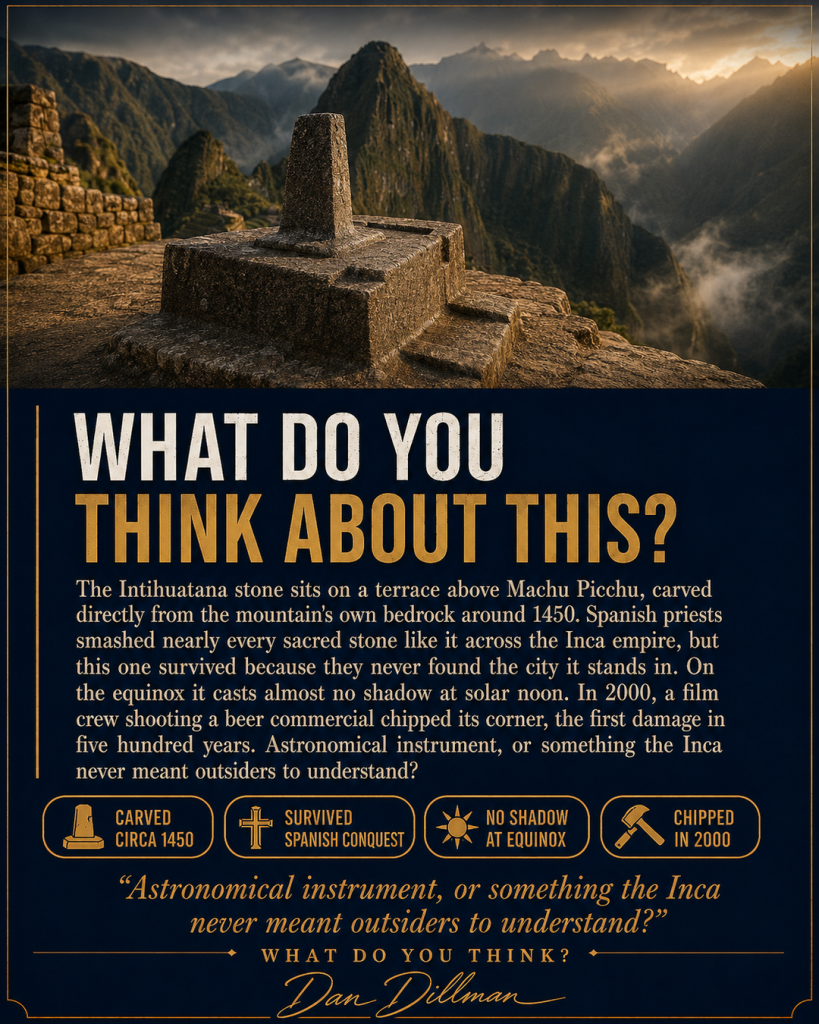
The Intihuatana stone sits on a terrace above Machu Picchu, carved directly from the mountain’s own bedrock around 1450 under the Inca ruler Pachacuti. Its name translates roughly to hitching post of the sun. On the equinox, the stone casts almost no shadow at solar noon, a level of astronomical precision that took generations of observation to achieve without a single written record, since the Inca kept no written language at all. Machu Picchu itself was abandoned within a century, likely during the Spanish conquest, and sat hidden above the Urubamba River until 1911, when it was shown to the wider world.
In 2000, a film crew shooting a beer commercial dropped a crane and chipped a piece off the stone’s corner, the first damage the Intihuatana had suffered in five hundred years of surviving empires, weather, and conquest.
Makes you wonder what else the Inca built to that same precision that the Spanish did find and destroy before anyone thought to write it down.
Astronomical instrument, or something the Inca never meant outsiders to understand?