What do you think about this?
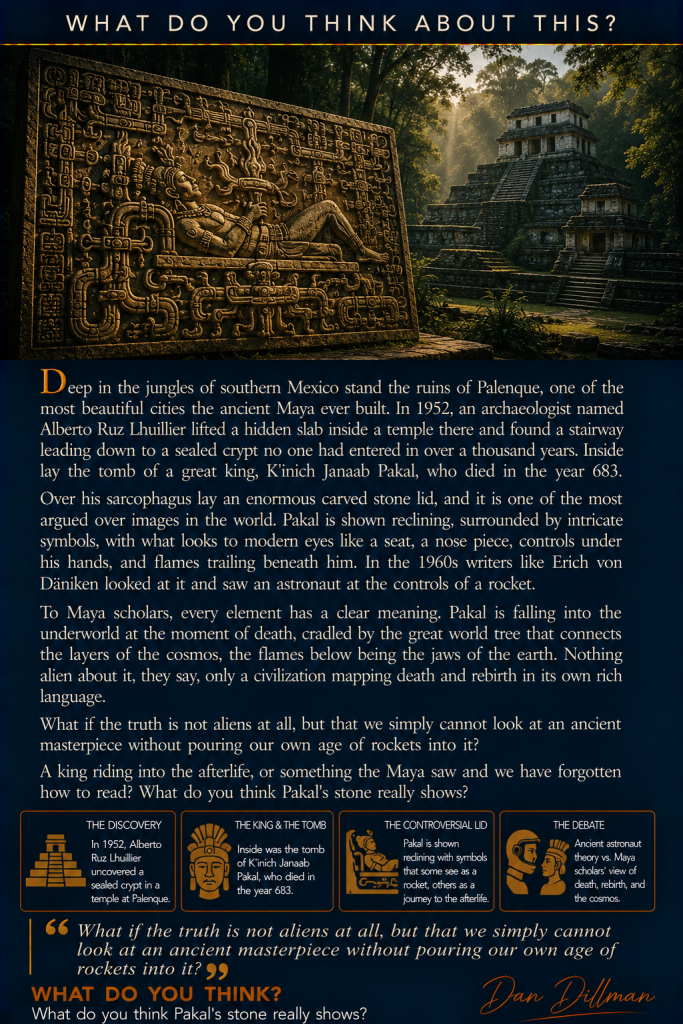
Deep in the jungles of southern Mexico stand the ruins of Palenque, one of the most beautiful cities the ancient Maya ever built. In 1952, an archaeologist named Alberto Ruz Lhuillier lifted a hidden slab inside a temple there and found a stairway leading down to a sealed crypt no one had entered in over a thousand years. Inside lay the tomb of a great king, K’inich Janaab Pakal, who died in the year 683.
Over his sarcophagus lay an enormous carved stone lid, and it is one of the most argued over images in the world. Pakal is shown reclining, surrounded by intricate symbols, with what looks to modern eyes like a seat, a nose piece, controls under his hands, and flames trailing beneath him. In the 1960s writers like Erich von Däniken looked at it and saw an astronaut at the controls of a rocket.
To Maya scholars, every element has a clear meaning. Pakal is falling into the underworld at the moment of death, cradled by the great world tree that connects the layers of the cosmos, the flames below being the jaws of the earth. Nothing alien about it, they say, only a civilization mapping death and rebirth in its own rich language.
What if the truth is not aliens at all, but that we simply cannot look at an ancient masterpiece without pouring our own age of rockets into it?
A king riding into the afterlife, or something the Maya saw and we have forgotten how to read? What do you think Pakal’s stone really shows?