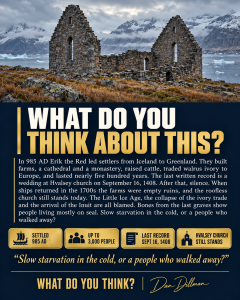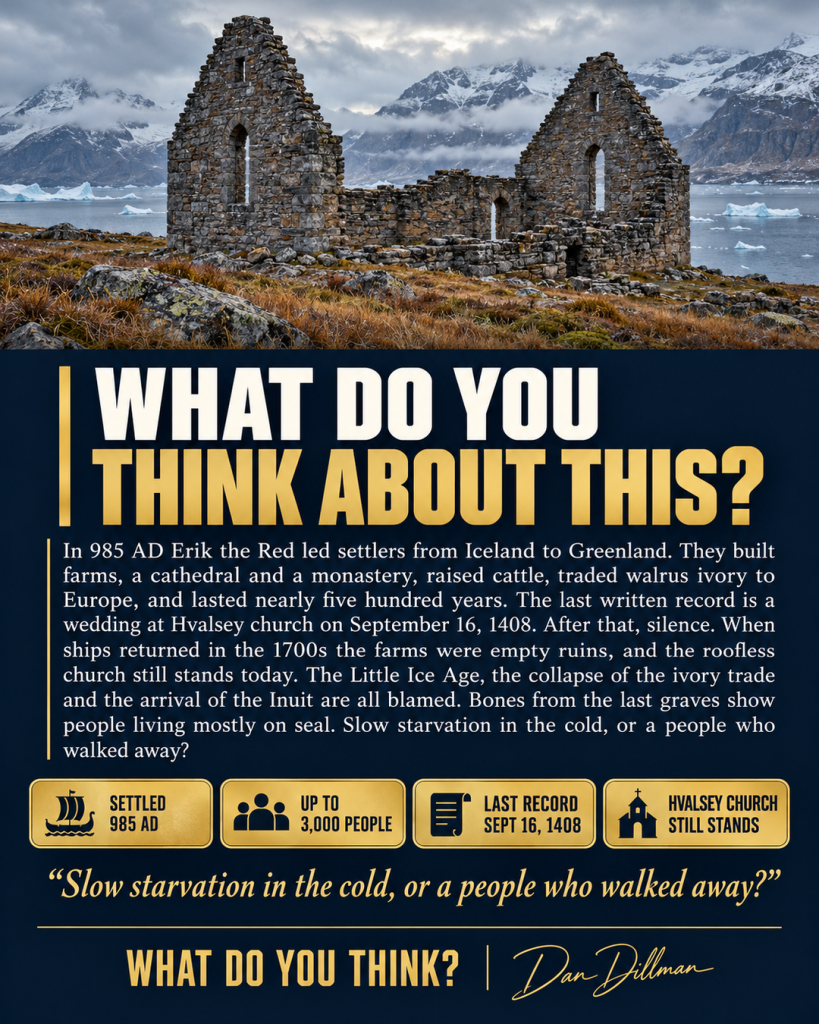
In 985 AD Erik the Red led a fleet of settlers from Iceland to a coast he had named Greenland, a sales pitch if there ever was one. They built farms, raised cattle and sheep, and traded walrus ivory to Europe. At its height the colony had perhaps two to three thousand people, a cathedral, a monastery and a bishop.
They lasted nearly five hundred years. Then they were gone.
The last written record of the Greenland Norse is a wedding. On September 16, 1408, a couple named Thorstein Olafsson and Sigrid Bjornsdottir were married at the stone church at Hvalsey, and the event was recorded in letters that made it back to Iceland. After that, silence. When a ship finally reached the settlements again in the 1700s, the Norse farms were empty ruins. The Hvalsey church still stands today, roofless, with its walls intact.
What happened to them is still argued over. The climate turned colder in what we now call the Little Ice Age. The walrus ivory trade collapsed when elephant ivory flooded Europe. The Inuit arrived from the north. Some say the Norse starved, some say they sailed home, some say they were absorbed into the Inuit people. Bones from the last graves show people who were eating mostly seal, far from the cattle farmers who arrived.
Scholars have chased this question for a century and we are no closer to an answer.
Is it possible for an entire Christian nation to disappear from the map of Europe and leave nothing but a wedding announcement.
Slow starvation in the cold, or a people who walked away?