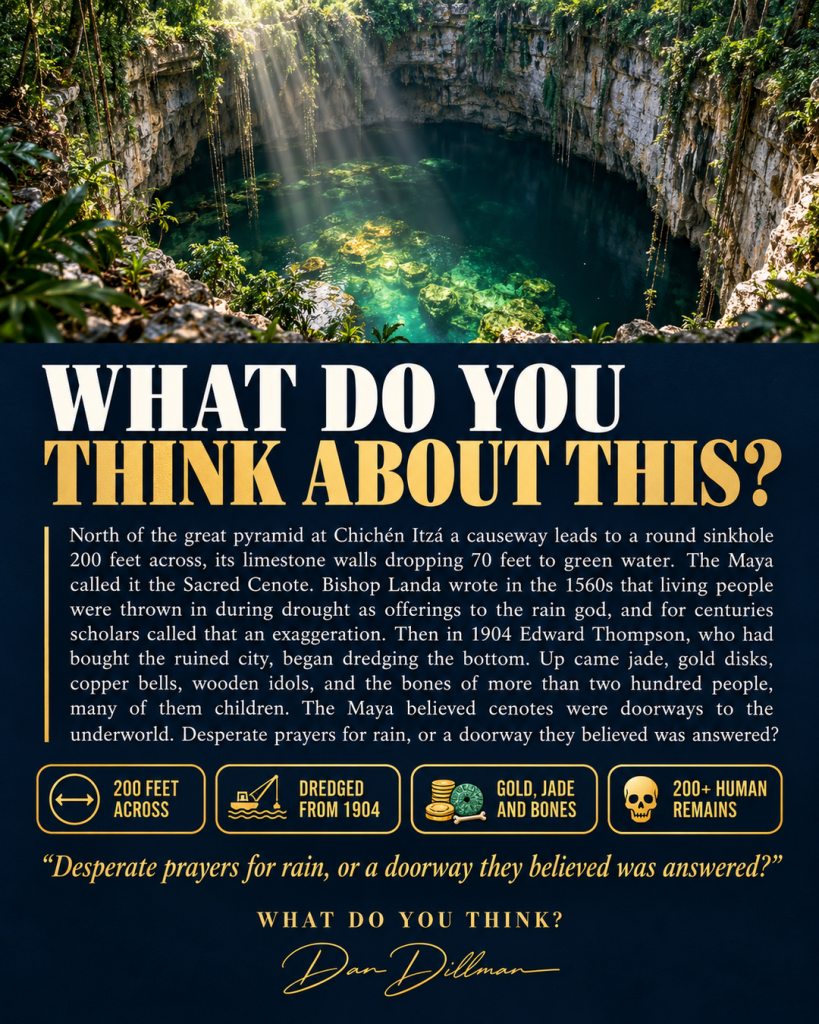
A few hundred yards north of the great pyramid at Chichén Itzá, a stone causeway leads to a hole in the earth. It is almost perfectly round, about 200 feet across, with sheer limestone walls dropping some 70 feet to green water. The Maya called it the Sacred Cenote. The Spanish called it the Well of Sacrifice.
Bishop Diego de Landa, the same man who burned the Maya books, wrote in the 1560s that the Maya threw living people into this well in times of drought, along with their most precious things, as offerings to the rain god Chaac. For three centuries most scholars treated that as a conquistador’s exaggeration.
Then in 1904 an American named Edward Thompson, who had bought the entire ruined city as a hacienda, set up a dredge on the rim and began hauling up the bottom.
What came up changed everything. Jade carvings. Gold disks worked with images of battle and sacrifice. Copper bells, obsidian blades, wooden idols preserved in the mud, incense, rubber, textiles. And bones. The remains of more than two hundred people, many of them children, some showing marks of violence.
Thompson smuggled much of the gold to Harvard’s Peabody Museum. Mexico fought for decades to get it back. Divers returned in the 1960s with better equipment and found more. Nobody has ever reached the bottom of everything that is down there.
The Maya believed cenotes were doorways to Xibalba, the underworld. Some say the gold and jade were gifts to visitors from somewhere else. The Maya would have told you the visitors were gods.
Makes you wonder what it takes to make a people give their best, and their children, to a hole in the ground.
Desperate prayers for rain, or a doorway they believed was answered?