
What do you think about this?
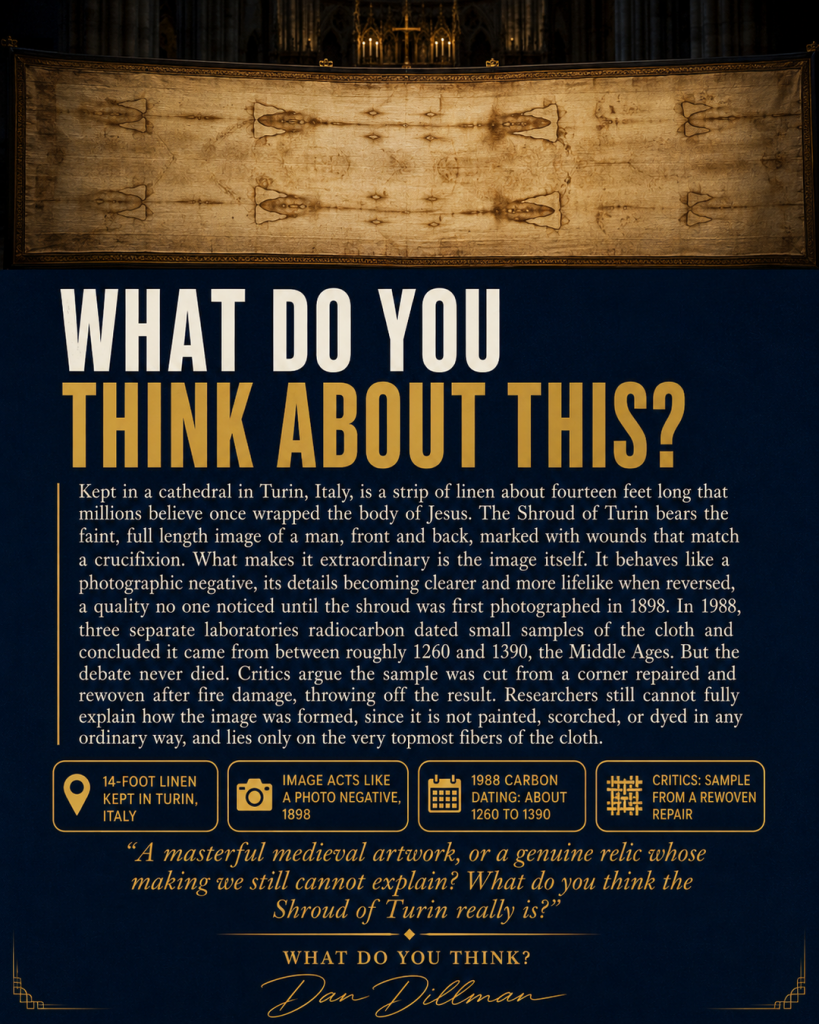
Kept in a cathedral in Turin, Italy, is a strip of linen about fourteen feet long that millions believe once wrapped the body of Jesus. The Shroud of Turin bears the faint, full length image of a man, front and back, marked with wounds that match a crucifixion. What makes it extraordinary is the image itself. It behaves like a photographic negative, its details becoming clearer and more lifelike when reversed, a quality no one noticed until the shroud was first photographed in 1898.
For centuries it has been argued over. In 1988, three separate laboratories radiocarbon dated small samples of the cloth and concluded it came from between roughly 1260 and 1390, the Middle Ages, seeming to settle the matter as a medieval creation.
But the debate never died. Critics of the test argue the sample was cut from a corner that had been repaired and rewoven after fire damage, throwing off the result. Researchers still cannot fully explain how the image was formed, since it is not painted, scorched, or dyed in any ordinary way, and lies only on the very topmost fibers of the cloth.
Is it possible that a piece of cloth could carry a genuine mystery science has not cracked, whatever one believes about whose image it holds?
A masterful medieval artwork, or a genuine relic whose making we still cannot explain? What do you think the Shroud of Turin really is?