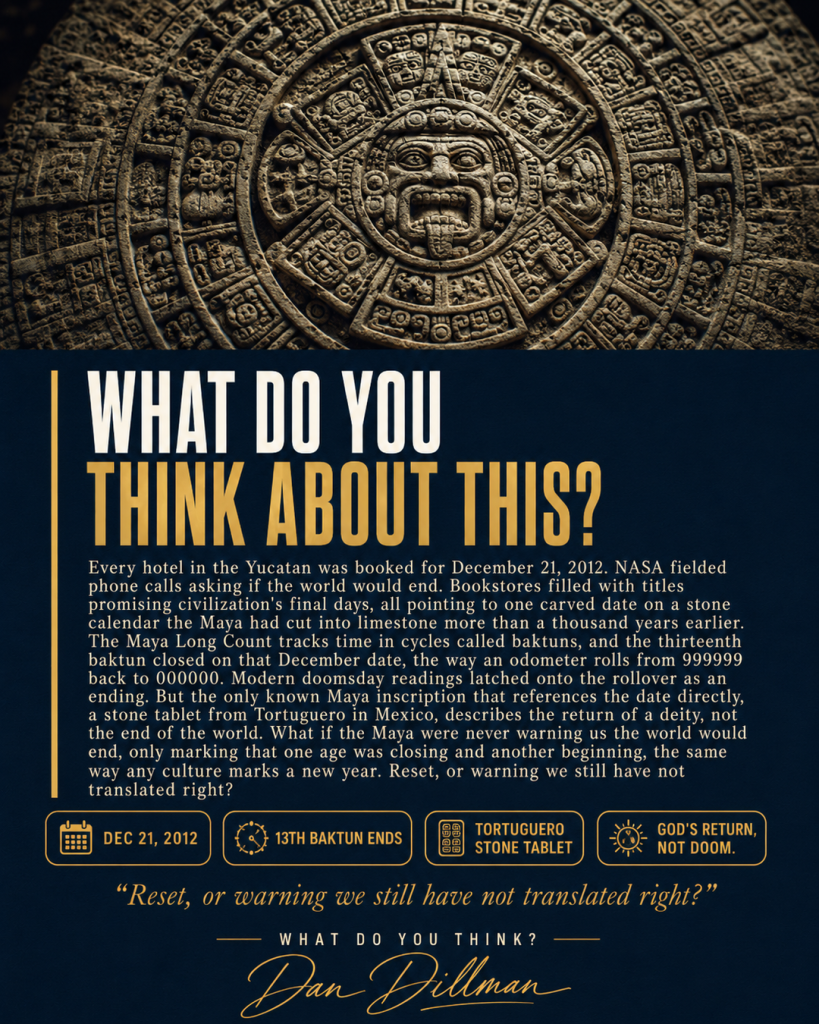

Every hotel in the Yucatan was booked for December 21, 2012. NASA fielded phone calls asking if the world would end. Bookstores filled with titles promising civilization’s final days, all pointing to one carved date on a stone calendar the Maya had cut into limestone more than a thousand years earlier.
The Maya Long Count tracks time in cycles called baktuns, and the thirteenth baktun closed on that December date, the way an odometer rolls from 999999 back to 000000. Modern doomsday readings latched onto the rollover as an ending. But the only known Maya inscription that references the date directly, a stone tablet from Tortuguero in Mexico, describes the return of a deity, not the end of the world. Maya scholars who have spent careers reading these glyphs say a culture that built pyramids to track Venus for centuries was not in the business of predicting its own extinction.
So where did the panic come from. Some blame a chain of pop science books, some blame a Hollywood disaster film that came out that same year, some think a fragment of real astronomical knowledge got flattened into a headline until nobody could tell prophecy from marketing.
What if the Maya were never warning us the world would end, only marking that one age was closing and another beginning, the same way any culture marks a new year. Getting the calendar wrong may be the only apocalypse that ever actually happened.
Reset, or warning we still have not translated right?