What do you think about this?
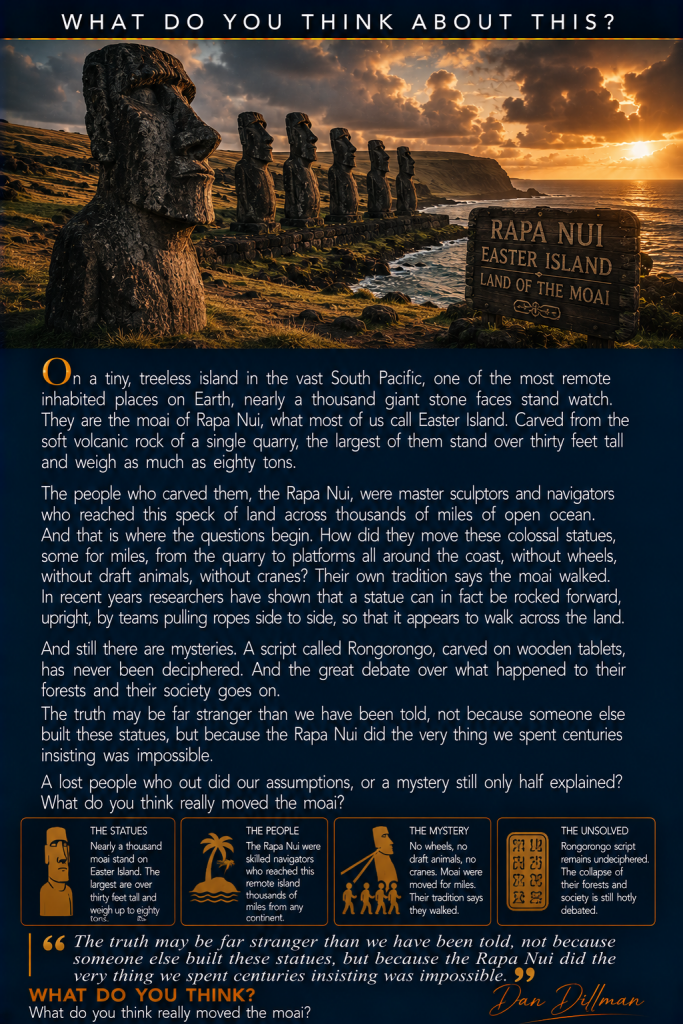
On a tiny, treeless island in the vast South Pacific, one of the most remote inhabited places on Earth, nearly a thousand giant stone faces stand watch. They are the moai of Rapa Nui, what most of us call Easter Island. Carved from the soft volcanic rock of a single quarry, the largest of them stand over thirty feet tall and weigh as much as eighty tons.
The people who carved them, the Rapa Nui, were master sculptors and navigators who reached this speck of land across thousands of miles of open ocean. And that is where the questions begin. How did they move these colossal statues, some for miles, from the quarry to platforms all around the coast, without wheels, without draft animals, without cranes? Their own tradition says the moai walked. In recent years researchers have shown that a statue can in fact be rocked forward, upright, by teams pulling ropes side to side, so that it appears to walk across the land.
And still there are mysteries. A script called Rongorongo, carved on wooden tablets, has never been deciphered. And the great debate over what happened to their forests and their society goes on.
The truth may be far stranger than we have been told, not because someone else built these statues, but because the Rapa Nui did the very thing we spent centuries insisting was impossible.
A lost people who out did our assumptions, or a mystery still only half explained? What do you think really moved the moai?