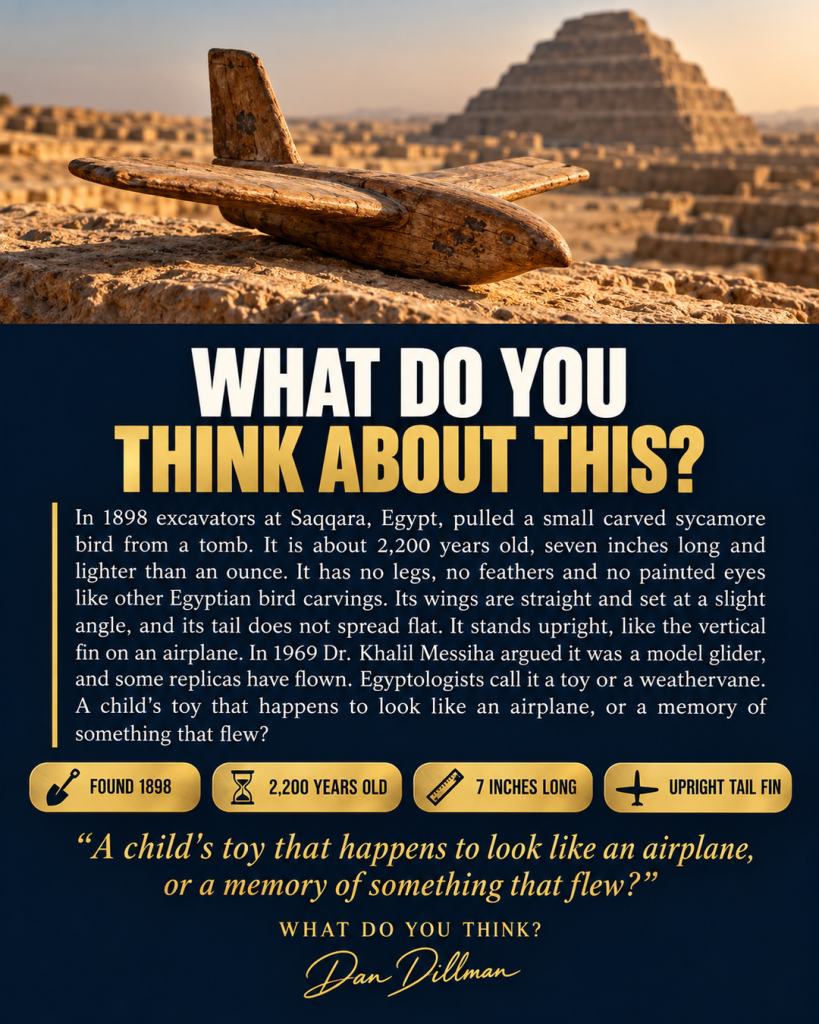
In 1898 excavators working a tomb at Saqqara, the great burial ground south of Cairo, brought up a small carved object made of sycamore wood. It was about seven inches long and weighed less than an ounce. They catalogued it as a bird and put it in a box.
It is about 2,200 years old. And it does not look like any other bird the Egyptians carved.
Real Egyptian bird figures have legs, feathers and painted eyes. This one has none. Its wings are straight and set at a slight angle, like the wings of an aircraft. Its body is smooth and narrow. And its tail is not spread flat like a bird’s. It stands straight up, exactly like the vertical stabilizer on the tail of a plane.
In 1969 the Egyptian doctor and model maker Khalil Messiha pulled it from storage and made a claim that has never gone away. He said the Saqqara Bird was a model of a glider. Some who have built scale replicas say it flies. Others say it needs a tailplane the original never had. Egyptologists generally call it a toy, a weathervane, or a ceremonial object.
Here is what we know for certain. Someone two thousand years ago carved a shape that we would not see again until the Wright brothers.
I have studied this little piece of wood for years. Coincidence can only stretch so far.
Could it be that the knowledge of flight is far older than our textbooks allow.
A child’s toy that happens to look like an airplane, or a memory of something that flew?