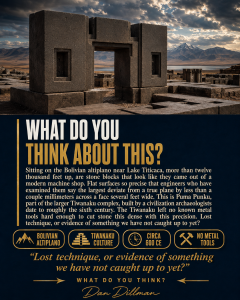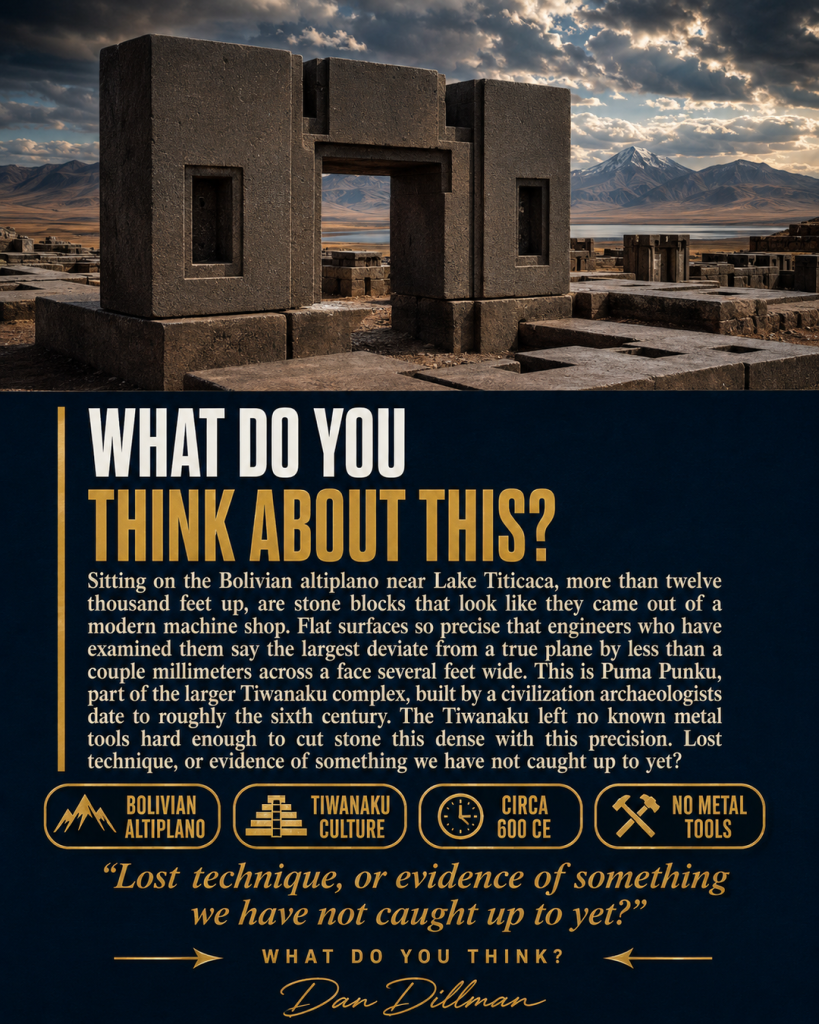

Sitting on the Bolivian altiplano near Lake Titicaca, more than twelve thousand feet up, are stone blocks that look like they came out of a modern machine shop. Flat surfaces so precise that engineers who have examined them say the largest deviate from a true plane by less than a couple millimeters across a face several feet wide. Repeating H-shaped notches cut into andesite and diorite, some of the hardest stone in the region, interlock so consistently across dozens of blocks that they appear to have been made from a single master template.
This is Puma Punku, part of the larger Tiwanaku complex, built by a civilization archaeologists date to roughly the sixth century, centuries before the Inca stonework that gets far more attention. The Tiwanaku left no known metal tools hard enough to cut stone this dense with this precision, and no evidence of the kind of standardized templates modern machining would require. Some of the largest blocks weigh well over one hundred tons, quarried from sites miles away, with no clear record of how they were moved.
Mainstream archaeologists argue for long, patient stone-on-stone abrasion techniques lost to time. Nobody disputes that the blocks exist exactly as precise as they look.
Could it be that a civilization this far back solved a stoneworking problem modern tools still struggle to replicate, using methods nobody wrote down.
Lost technique, or evidence of something we have not caught up to yet?